Tyre recycling equipment plays a critical role in modern waste management and circular economy systems. End-of-life tyres are among the most challenging waste streams to process due to their durability, elasticity, and composite structure. Effective tyre recycling requires heavy-duty machinery capable of breaking down rubber while separating steel and textile components for reuse.
As global regulations tighten and landfill restrictions increase, tyre recycling equipment has become essential for recycling facilities, industrial processors, and waste management operators seeking efficient, scalable solutions.
Understanding the tyre recycling process
Tyre recycling involves converting whole tyres into reusable raw materials, primarily rubber granules, steel wire, and textile fibre. The process is typically multi-stage, combining mechanical size reduction with material separation.
Unlike many other recycling streams, tyres resist cutting and tearing, which means tyre recycling equipment must deliver high torque, controlled shear forces, and durable wear components. Systems are designed to progressively reduce tyre size while maintaining material integrity for downstream applications such as rubberised asphalt, playground surfaces, moulded products, and fuel alternatives.
Primary tyre shredders

Primary tyre shredders are the first stage of tyre recycling equipment. These machines are designed to process whole tyres, including passenger, truck, and off-the-road tyres.
They operate using slow-speed, high-torque cutting shafts that tear tyres into large shreds. This size reduction makes tyres manageable for further processing while protecting downstream machinery from excessive stress. Primary shredders are typically built with hardened steel cutters, replaceable wear parts, and hydraulic drive systems to handle variable loads.
Secondary granulators and size reduction

After initial shredding, secondary granulators further reduce tyre material into smaller, more uniform pieces. This stage is essential for preparing rubber for separation and final refinement.
Granulators use rotating knives and fixed cutting surfaces to achieve precise particle sizing. In tyre recycling facilities, multiple granulation stages may be used to gradually reduce material size while improving consistency. This controlled reduction improves separation efficiency and final product quality.
Steel wire separation equipment
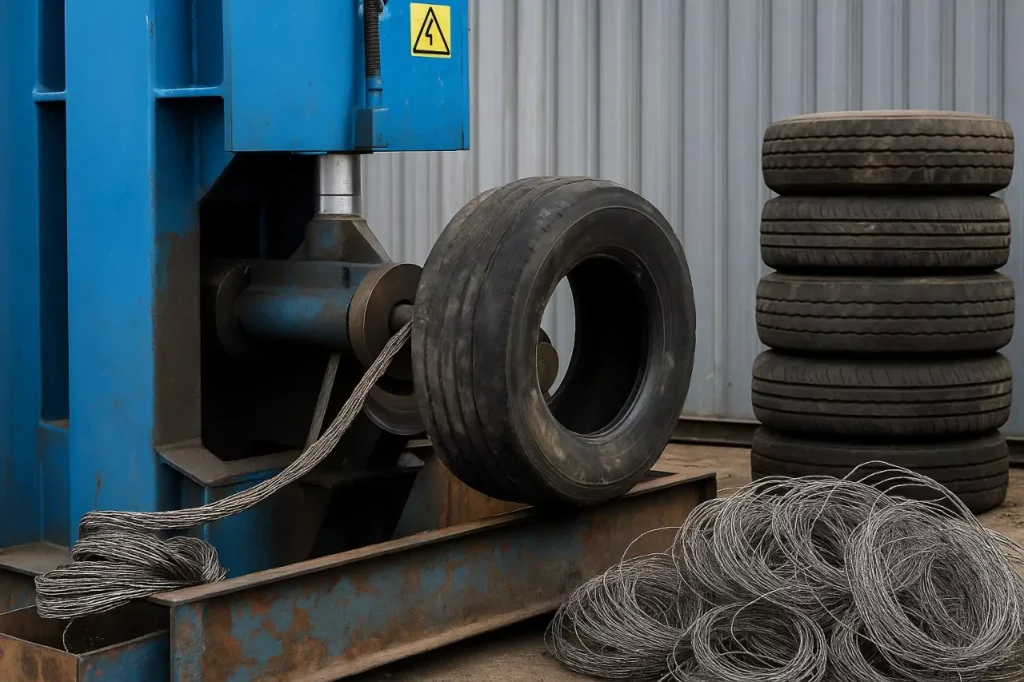
Tyres contain a significant amount of steel reinforcement, particularly in bead and belt structures. Steel wire separators are a vital component of tyre recycling equipment, ensuring clean separation of metal from rubber.
Magnetic separators are commonly used at multiple points in the process to extract steel fragments. Advanced systems may include drum magnets, overband magnets, and vibrating conveyors to maximise steel recovery while minimising rubber contamination. Recovered steel can then be recycled within the metal industry.
Fibre separation systems

In addition to steel, tyres also contain textile fibres that must be removed to produce high-quality rubber output. Fibre separation systems use a combination of air classification, vibration, and screening to isolate lightweight textile material from rubber granules.
Effective fibre removal is critical for applications where rubber purity is required, such as moulded products or high-performance surfaces. Modern tyre recycling equipment integrates fibre separation into automated lines to improve throughput and reduce manual intervention.
Cryogenic and ambient grinding systems

Final rubber size reduction is typically achieved through either ambient or cryogenic grinding systems. Ambient grinding processes rubber at normal temperatures using mechanical force, producing granules or powder depending on system configuration.
Cryogenic grinding involves cooling rubber with liquid nitrogen until it becomes brittle, allowing it to fracture cleanly into fine particles. While cryogenic systems require higher capital and operating costs, they offer superior particle shape control and minimal thermal degradation. The choice between ambient and cryogenic tyre recycling equipment depends on output requirements and end-use applications.
Integrated tyre recycling plants
Modern tyre recycling plants combine multiple equipment stages into fully integrated systems. These plants are designed for continuous operation, automated material handling, and high-volume throughput.
Integrated tyre recycling equipment improves operational efficiency by synchronising shredding, granulation, separation, and grinding processes. These systems reduce downtime, enhance material recovery rates, and allow operators to scale production according to demand.
Industrial and environmental benefits
Tyre recycling equipment supports both environmental compliance and commercial opportunity. By diverting tyres from landfill and illegal dumping, recycling facilities reduce fire risk, land pollution, and long-term environmental damage.
Recovered rubber, steel, and fibre materials re-enter industrial supply chains, reducing reliance on virgin resources. For operators, modern tyre recycling equipment offers long-term value through material resale, regulatory compliance, and sustainable waste management solutions.
The role of tyre recycling equipment in sustainable systems
As sustainability requirements continue to evolve, tyre recycling equipment will remain central to responsible waste processing strategies. Advances in automation, energy efficiency, and material recovery are making tyre recycling more viable and scalable across regions.
For recycling facilities, municipalities, and industrial operators, investing in the right tyre recycling equipment is not just an environmental decision, but a strategic move toward resilient, future-focused waste management systems.