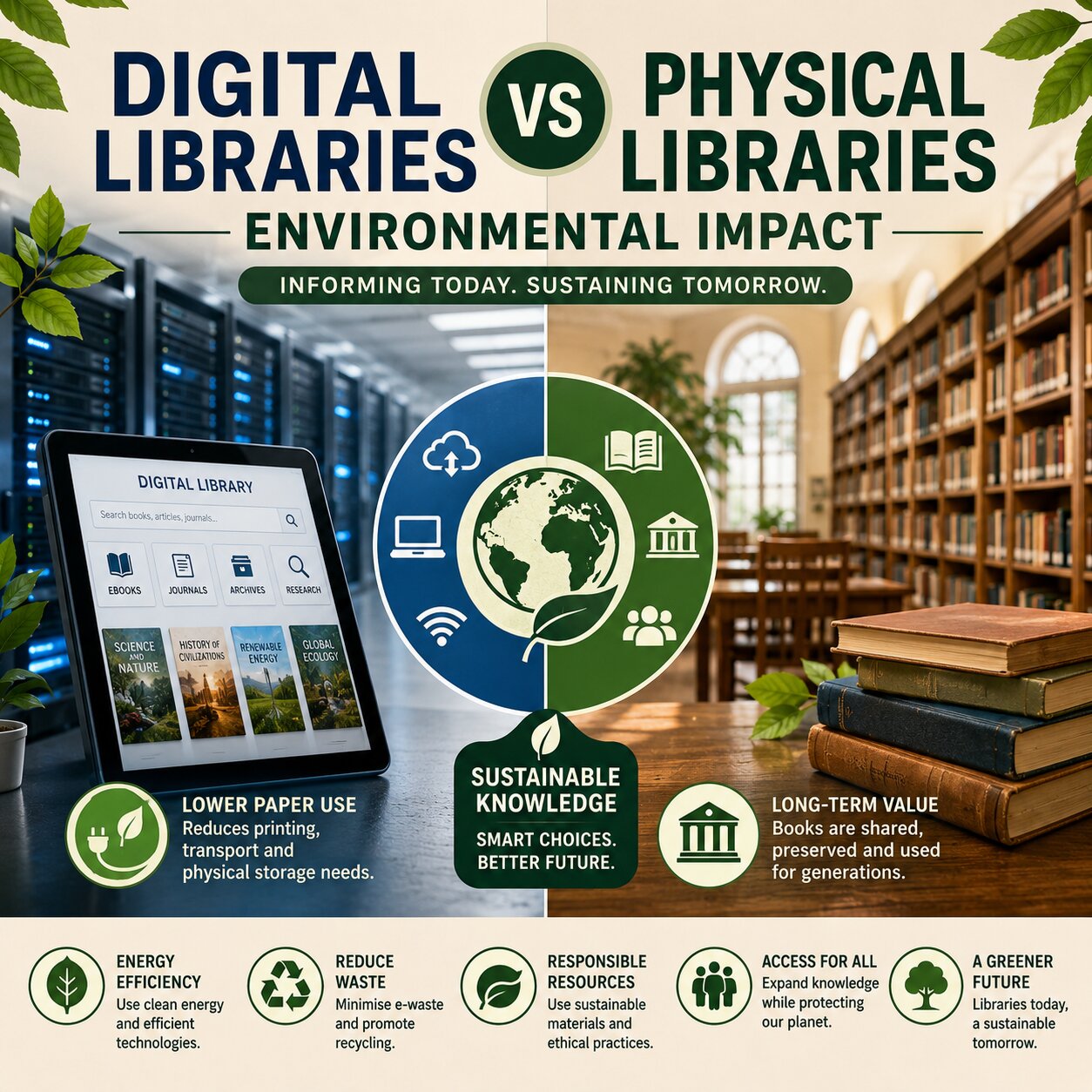
Libraries continue to play a critical role in education, research, culture, and community development. However, as technology advances and digital access becomes more widespread, discussions around sustainability and environmental impact are becoming increasingly important. One of the biggest modern debates is the environmental impact of digital libraries compared to physical libraries.
While digital libraries reduce paper usage and transportation needs, they also rely heavily on data centres, electricity, manufacturing, and electronic infrastructure. Physical libraries, on the other hand, require buildings, lighting, climate control, furniture, and printed materials. Understanding the environmental strengths and challenges of both systems is essential for creating more sustainable library solutions in the future.
The environmental impact of physical libraries

Physical libraries have long served as community hubs and educational centres. Their environmental footprint largely comes from building operations, construction materials, paper production, transportation, and maintenance requirements.
Library buildings consume electricity for lighting, heating, cooling, security systems, computers, and public facilities. Larger libraries may require advanced climate control systems to preserve books, archives, and sensitive historical documents. Older buildings can be especially energy-intensive if they lack modern efficiency upgrades.
Printed books also carry environmental costs through paper production, ink manufacturing, printing, packaging, and shipping. The transportation of books between publishers, warehouses, libraries, and users contributes to emissions over time. Large library systems may also move books frequently between branches.
However, physical libraries also offer important sustainability advantages. A single physical book can be borrowed by hundreds of readers over many years, reducing the need for individual ownership and mass production. Libraries also promote resource sharing, which supports circular economy principles and reduces consumer waste.
Modern sustainable library design is helping reduce the environmental footprint of physical libraries through energy-efficient lighting, solar power systems, water-saving technologies, sustainable building materials, and smart climate control systems.
The environmental impact of digital libraries

Digital libraries eliminate many of the environmental costs associated with paper production and physical transportation. Users can instantly access ebooks, journals, archives, and research materials without printing or shipping physical copies.
This reduces paper consumption, lowers demand for storage space, and decreases transportation-related emissions. Digital access also allows libraries to reach remote communities without requiring new buildings or large physical collections.
However, digital systems are not environmentally neutral. Digital libraries depend on servers, cloud infrastructure, data centres, internet networks, and electronic devices such as computers, tablets, smartphones, and e-readers. These technologies consume electricity continuously and require significant infrastructure support.
Data centres in particular have become major energy consumers worldwide. They require constant cooling, backup systems, and uninterrupted power supplies to maintain digital services. If powered by fossil fuels, these systems can contribute heavily to carbon emissions.
Electronic waste is another growing concern. Devices eventually become outdated or damaged, creating environmental challenges linked to manufacturing, mining rare materials, and disposal processes.
Despite these concerns, digital libraries can become significantly more sustainable when powered by renewable energy systems and supported by energy-efficient technologies.
Comparing sustainability factors
The environmental impact of digital and physical libraries depends heavily on how each system is designed, managed, and used. Neither option is entirely sustainable or entirely harmful on its own.
Several factors influence sustainability comparisons:
- Energy consumption
- Building operations and maintenance
- Paper production and printing
- Data centre electricity usage
- Transportation and logistics
- Device manufacturing and electronic waste
- Resource sharing and long-term usage
- Renewable energy integration
For example, a poorly insulated physical library with outdated systems may consume more energy than a well-optimised digital library platform powered by renewable energy. At the same time, large-scale digital systems relying on fossil-fuel-powered infrastructure may create larger emissions than a community library focused on long-term shared book usage.
The lifespan of resources also matters. A printed book borrowed hundreds of times can be highly sustainable, while frequently replacing digital devices may create ongoing environmental costs.
The rise of hybrid library models

Many modern institutions are now embracing hybrid library systems that combine digital and physical resources. This approach allows libraries to balance accessibility, sustainability, and community engagement more effectively.
Digital collections reduce storage pressures and increase access to global information, while physical libraries continue supporting learning spaces, archives, public programmes, and social interaction. Hybrid models also allow libraries to reduce unnecessary printing while still preserving valuable physical collections.
Sustainable systems technologies are increasingly helping libraries optimise both physical and digital operations. Smart lighting, efficient climate systems, digital catalogues, renewable energy integration, and intelligent building management systems all contribute to reducing environmental impact.
Future libraries may rely even more heavily on sustainable architecture, energy-efficient technology, low-carbon data infrastructure, and environmentally responsible resource management practices.
Building sustainable knowledge systems for the future
The debate around digital libraries vs physical libraries environmental impact is not about choosing one system over the other. Instead, it highlights the importance of designing smarter, more sustainable knowledge systems that combine the strengths of both approaches.
Physical libraries remain valuable cultural, educational, and community spaces, while digital libraries provide flexible access and reduce certain resource demands. The future of sustainable libraries will likely depend on balancing these systems carefully while embracing cleaner energy, efficient infrastructure, and responsible technology management.
As sustainability becomes a greater priority worldwide, libraries have an important opportunity to lead by example in how information, resources, and public services can evolve responsibly for future generations.