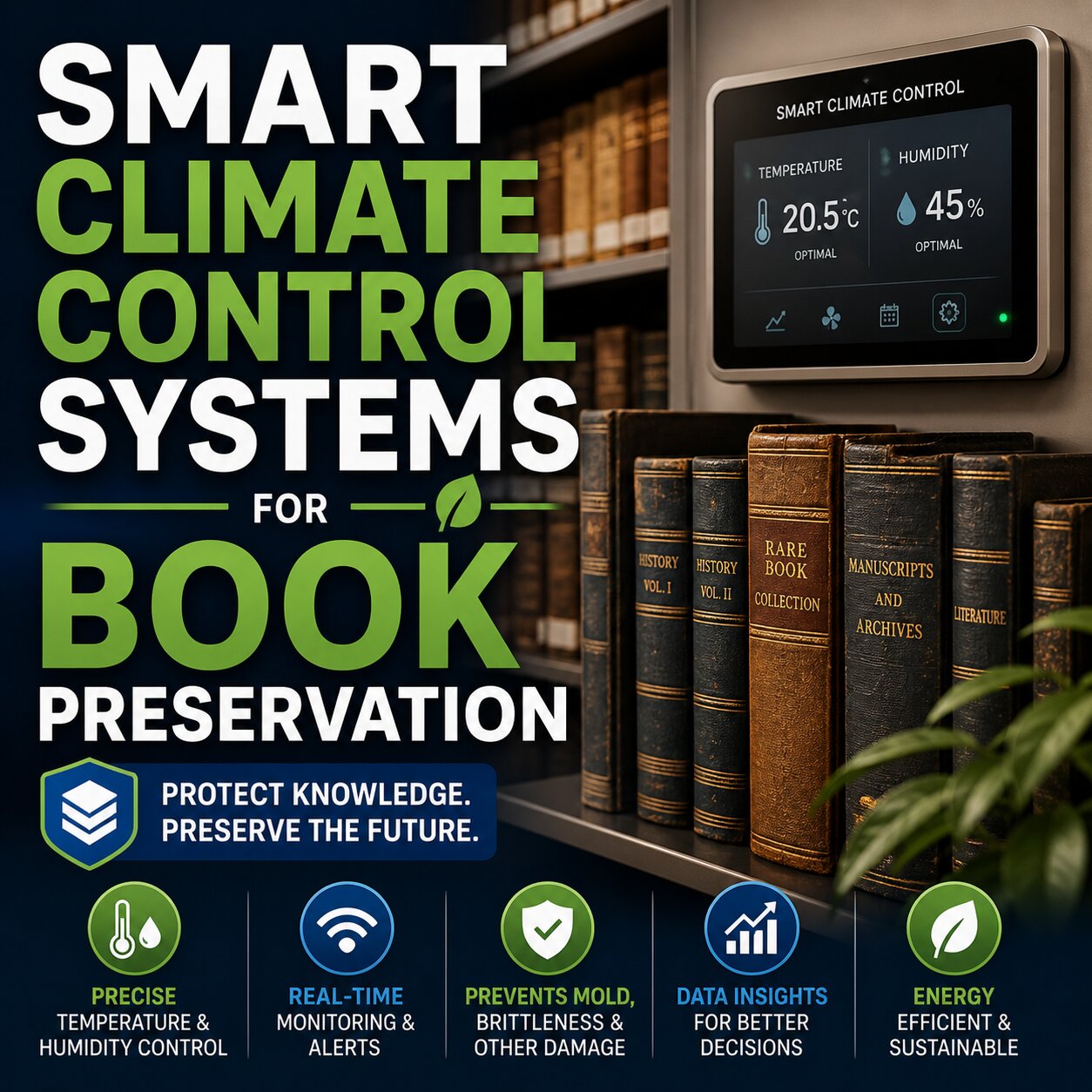
Preserving books, manuscripts, and archival materials requires more than careful handling. Environmental conditions play a critical role in determining how long these materials last. Smart climate control systems for book preservation are becoming essential tools for libraries, archives, and facilities managers who want to protect valuable collections.
From temperature fluctuations to humidity damage, even minor environmental changes can cause long-term deterioration. Modern smart systems provide precise control and real-time monitoring, ensuring that books remain in optimal conditions at all times.
Let’s explore how smart climate control systems for library book preservation are transforming facility management and safeguarding knowledge for future generations.
Why Environmental Control Is Critical for Books

Books are highly sensitive to their surroundings. Paper, ink, adhesives, and bindings all react to environmental changes, especially temperature and humidity.
High humidity levels can lead to mould growth, warped pages, and weakened bindings. On the other hand, low humidity can cause paper to become brittle and crack over time. Temperature extremes accelerate chemical degradation, shortening the lifespan of books and documents.
Traditional climate control systems often struggle to maintain consistent conditions across large facilities. Variations between rooms or even shelves can lead to uneven preservation outcomes.
Smart climate control systems for book preservation address these challenges by maintaining stable, consistent environments tailored specifically for sensitive materials.
How Smart Climate Control Systems Work

Smart climate control systems for book preservation combine sensors, automation, and data analytics to manage environmental conditions with precision. These systems continuously monitor temperature, humidity, and air quality in real time.
Sensors placed throughout a facility collect data and send it to a central system. This system then adjusts HVAC settings automatically to maintain optimal conditions. If a deviation occurs, the system responds immediately, preventing damage before it happens.
Many systems also include cloud-based dashboards, allowing facility managers to monitor conditions remotely. Alerts can be set to notify teams when thresholds are exceeded, ensuring quick intervention.
By automating these processes, smart systems reduce human error and improve consistency, making them far more effective than traditional manual controls.
Benefits for Libraries and Archival Facilities

Implementing smart climate control systems for book preservation offers a wide range of benefits for facilities managing valuable collections.
First, they significantly extend the lifespan of books and documents. By maintaining stable conditions, these systems slow down the natural ageing process and reduce the risk of damage.
Second, they improve operational efficiency. Automated controls reduce the need for constant manual adjustments, freeing up staff to focus on other important tasks.
Third, they support sustainability goals. Smart systems optimise energy use by adjusting output based on real-time conditions, reducing unnecessary energy consumption.
Finally, they provide valuable data insights. Historical data can be analysed to identify trends, predict potential issues, and refine preservation strategies over time.
Key Features to Look For in Smart Systems

When selecting smart climate control systems for book preservation, facilities managers should prioritise features that support accuracy, reliability, and ease of use:
- Real-time temperature and humidity monitoring
- Automated HVAC adjustments based on sensor data
- Remote access via cloud-based dashboards
- Customisable alerts and notifications
- Data logging and reporting for long-term analysis
- Integration with existing building management systems
- Energy-efficient operation and optimisation tools
Choosing the right system ensures that your facility can maintain ideal conditions consistently while minimising operational costs.
The Future of Book Preservation in Smart Facilities
Smart climate control systems for book preservation are no longer a luxury. They are becoming a necessity as facilities aim to protect valuable collections while improving efficiency and sustainability.
As technology continues to evolve, these systems will become even more advanced, incorporating artificial intelligence and predictive analytics. This will allow facilities to anticipate environmental risks before they occur and take proactive measures.
For libraries, archives, and institutions responsible for preserving knowledge, investing in smart climate control systems is a forward-thinking decision. It ensures that books and historical materials remain intact, accessible, and protected for generations to come.