Construction projects involve far more than bricks, concrete, and steel. Behind every successful development is a coordinated effort to manage facilities, assets, stakeholders, budgets, risks, and operational requirements. This is where the Facility Management Body of Knowledge (FMBOK) becomes particularly valuable.
The FMBOK provides a structured framework for facility management professionals, helping them align people, places, processes, and technology throughout the lifecycle of a built environment. While often associated with completed buildings, its principles can also be applied during construction projects to improve outcomes and long-term asset performance.
By incorporating FMBOK concepts from the planning stage, project teams can create facilities that are easier to operate, maintain, and manage after construction is complete.
Understanding the FMBOK framework
The Facility Management Body of Knowledge serves as a comprehensive guide covering the key competencies and responsibilities involved in facilities management. It provides best practices for managing buildings, infrastructure, workplaces, and support services.
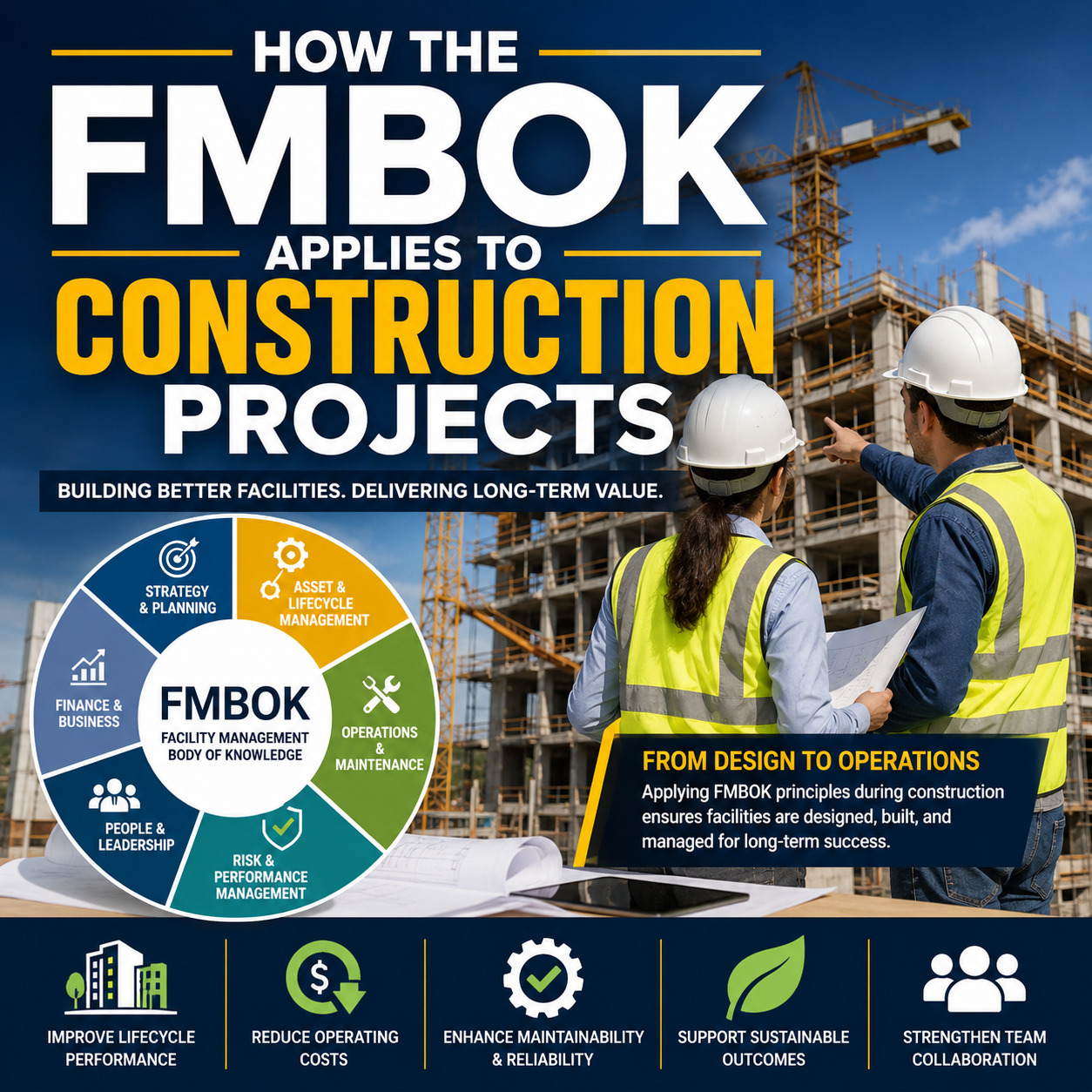
The framework covers areas such as operations and maintenance, sustainability, project management, leadership, finance, risk management, and strategic planning. These disciplines are highly relevant to construction projects because decisions made during construction directly impact future facility operations.
Rather than viewing construction and facilities management as separate activities, the FMBOK encourages a lifecycle approach that considers how a building will perform for decades after handover.
Applying FMBOK principles during construction
Construction projects can benefit significantly when facility management professionals are involved early in the process. Their operational expertise helps identify design choices that may affect maintenance costs, accessibility, energy efficiency, and long-term usability.
Some of the key ways the FMBOK applies during construction include:
- Lifecycle cost planning
- Maintenance accessibility reviews
- Sustainability integration
- Asset management planning
- Risk management assessments
- Operational readiness preparation
- Stakeholder engagement
- Space utilisation planning
Addressing these considerations during construction often reduces costly modifications after project completion.
Improving long-term facility performance
One of the primary goals of the FMBOK is ensuring that facilities continue to deliver value throughout their operational life. Construction teams that incorporate facility management perspectives are often able to create buildings that perform more efficiently over time.
This may include selecting durable materials, improving access to critical systems, designing efficient maintenance routes, and implementing technologies that support ongoing building management.
These decisions contribute to lower operating costs, reduced downtime, improved occupant experiences, and enhanced sustainability performance throughout the life of the asset.
Supporting collaboration between project teams
Construction projects involve architects, engineers, contractors, project managers, owners, and facility managers. The FMBOK promotes collaboration among these stakeholders by providing a common framework focused on long-term success.
Facility managers can provide practical insights regarding maintenance requirements, equipment replacement cycles, safety procedures, and operational workflows. Their input helps bridge the gap between design intentions and real-world building operations.
This collaborative approach often leads to more informed decision-making and fewer operational challenges after handover.
Building for the Future
The Facility Management Body of Knowledge offers valuable guidance that extends well beyond day-to-day building operations. When applied during construction projects, it helps ensure that facilities are designed, built, and commissioned with long-term performance in mind.
By integrating FMBOK principles throughout the construction process, project teams can create more sustainable, efficient, and manageable facilities that continue delivering value long after the final construction phase has been completed.