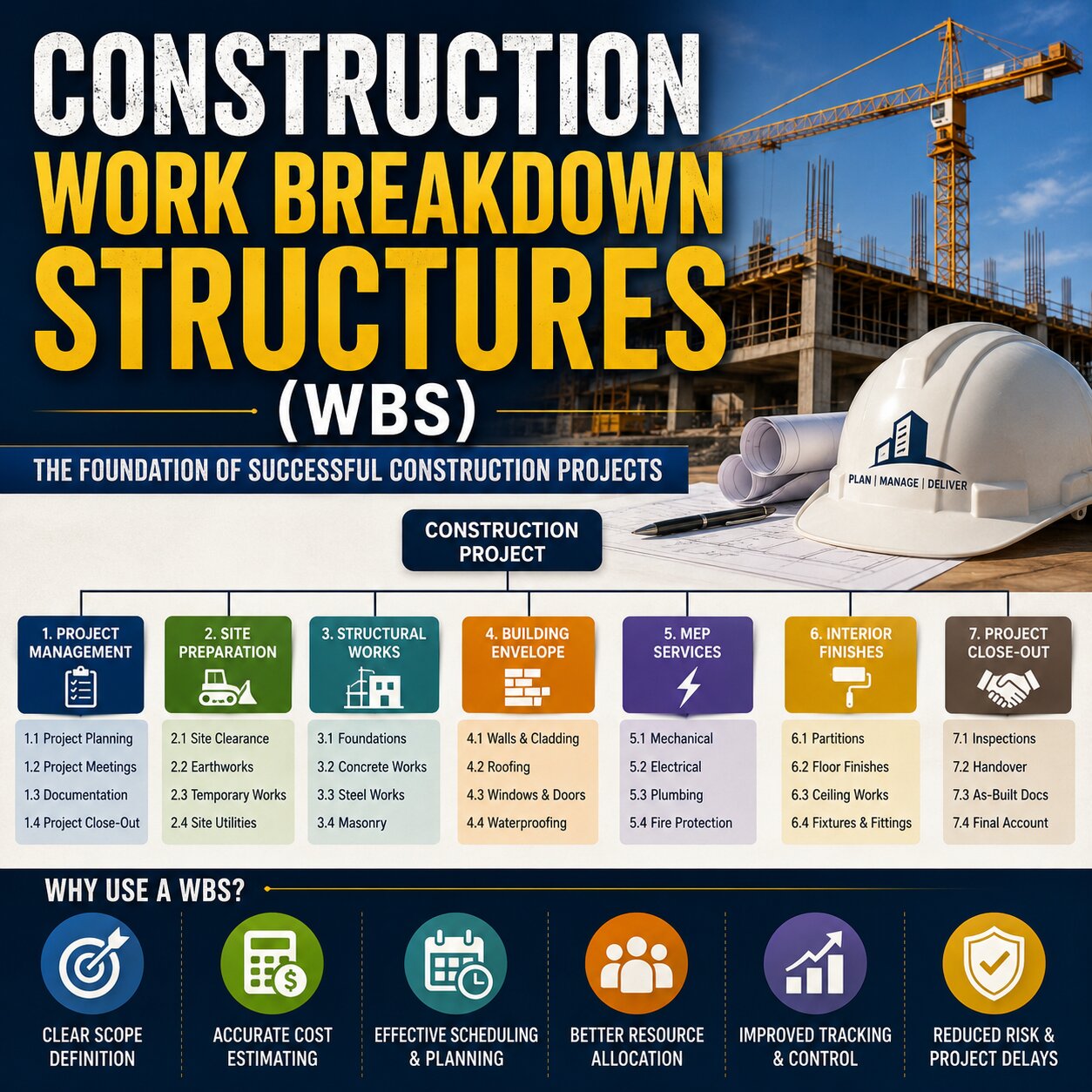
A Construction Work Breakdown Structures (WBS) document is one of the most valuable planning tools used in modern construction project management. By dividing a complex project into smaller, manageable components, a Work Breakdown Structure helps project teams organise work, allocate resources, estimate costs, and monitor progress more effectively.
Whether managing a residential development, commercial building, or major infrastructure project, a well-developed Construction Work Breakdown Structures (WBS) provides the framework upon which successful planning and execution are built. It improves communication between stakeholders while reducing the likelihood of missed tasks and costly delays.
Understanding how to develop and use a Work Breakdown Structure is therefore an essential skill for project managers, site managers, engineers, and construction professionals.
What Is A Construction Work Breakdown Structure?

A Construction Work Breakdown Structure is a hierarchical breakdown of every deliverable required to complete a construction project. Instead of viewing the project as one large undertaking, it separates the work into logical sections that become increasingly detailed.
The highest level usually represents the overall project. Each subsequent level divides the project into major phases, systems, or work packages until individual activities can be assigned, scheduled, and monitored.
For example, a commercial office development may first be divided into site preparation, foundations, structural works, building envelope, mechanical services, electrical installations, interior finishes, landscaping, and project close-out.
Each of these major deliverables can then be broken down into increasingly detailed work packages that are easier to estimate, manage, and execute.
Benefits Of Construction Work Breakdown Structures (WBS)
One of the biggest advantages of Construction Work Breakdown Structures (WBS) is improved project visibility. Every member of the project team gains a clear understanding of what work must be completed and how each activity contributes to the finished project.
A WBS also improves cost estimating by allowing estimators to assign budgets to individual work packages instead of attempting to estimate an entire project at once. This often results in greater accuracy during budgeting and procurement.
Scheduling becomes significantly easier because construction planners can sequence work packages, identify dependencies, and allocate labour and equipment more efficiently.
Risk management also benefits from a detailed WBS, as project managers can identify critical work packages that require closer monitoring before construction begins.
Developing An Effective WBS
Creating an effective Work Breakdown Structure begins by clearly defining the project’s final deliverables rather than individual tasks. The structure should focus on outcomes that contribute directly to project completion.
Each major deliverable should then be divided into smaller work packages that remain manageable while still representing meaningful portions of work. These work packages become the foundation for scheduling, procurement, budgeting, and resource allocation.
It is important that every element within the WBS follows the “100 Percent Rule”, meaning the combined work packages account for the entire project scope without overlap or duplication.
Regular reviews should also be conducted throughout the project lifecycle to ensure the WBS continues reflecting approved scope changes and construction progress.
Key Components Of A Construction WBS

An effective Work Breakdown Structure typically includes:
- Overall project objective
- Major construction phases
- Deliverables for each phase
- Individual work packages
- WBS numbering system
- Assigned responsibilities
- Cost allocation
- Resource planning
- Schedule integration
- Progress tracking milestones
Building Better Projects Through Better Planning
Every successful construction project begins with careful planning, and Construction Work Breakdown Structures (WBS) remain one of the industry’s most valuable planning tools. By organising work into clearly defined deliverables, project teams gain better control over scheduling, budgeting, communication, and risk management.
From small residential developments to complex infrastructure programmes, investing time in developing a comprehensive Work Breakdown Structure provides a solid foundation for project success. When combined with effective scheduling, cost management, and regular progress monitoring, a WBS helps construction professionals deliver projects more efficiently while maintaining quality and client satisfaction.