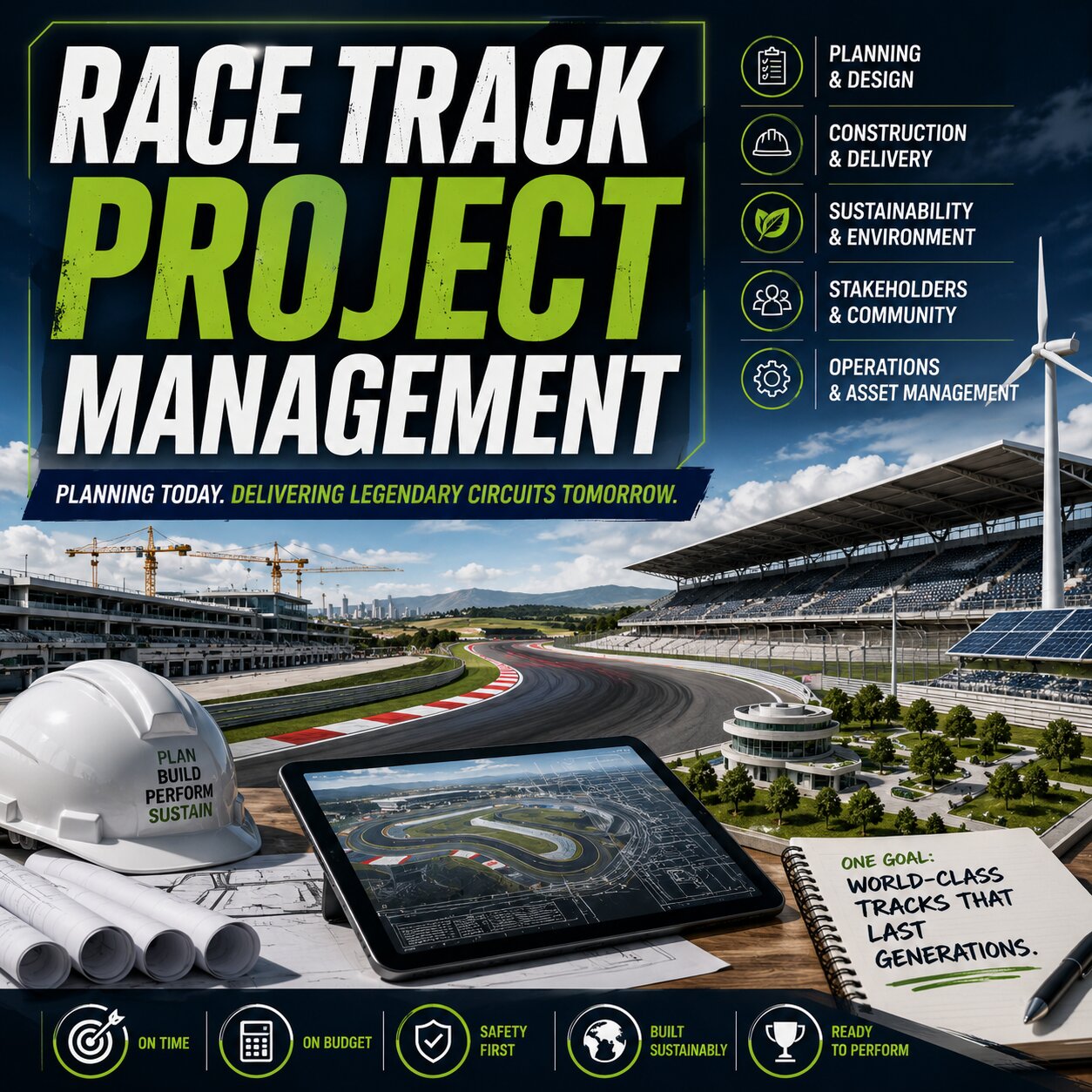
Race track project management is a specialised discipline that brings together engineering, construction, sustainability, finance, stakeholder engagement and operational planning to create facilities capable of hosting world-class motorsport events. Whether developing a permanent circuit or upgrading an existing venue, successful projects require careful coordination from concept through to long-term operation.
Modern race tracks are no longer simply stretches of asphalt. They are complex sporting and entertainment destinations that must satisfy governing bodies, teams, spectators, local communities and commercial partners while remaining financially and environmentally sustainable.
The Lifecycle of a Race Track Project

Every successful race track follows a structured project lifecycle. Initial planning begins with feasibility studies, site selection and business case development to determine whether a circuit is economically viable and suitable for its intended purpose.
Once approved, project managers coordinate designers, engineers, environmental specialists, contractors and regulatory authorities to ensure the development progresses according to scope, budget and schedule.
Throughout construction, quality management, safety compliance and risk mitigation remain top priorities. Upon completion, commissioning and operational testing ensure the venue meets international motorsport standards before hosting its first event.
Key Areas of Race Track Project Management
Race track developments involve multiple disciplines working together throughout the project.
- Feasibility studies and business case development
- Stakeholder and community engagement
- Infrastructure planning and construction
- Budget and financial management
- Environmental and sustainability planning
- Health, safety and risk management
- Procurement and contract management
- Event readiness and operational planning
- Technology integration
- Long-term asset management
Each element contributes to delivering a venue that performs efficiently throughout its operational life rather than simply meeting construction deadlines.
Balancing Performance with Sustainability

Today’s race track projects place increasing emphasis on sustainability alongside sporting excellence. Environmental impact assessments, renewable energy opportunities, water conservation, waste management and biodiversity protection are now considered during the earliest planning stages rather than as afterthoughts.
Project managers also evaluate public transport accessibility, electric vehicle infrastructure and opportunities to reduce the carbon footprint associated with major international events.
This integrated approach helps race tracks remain attractive to governing bodies, sponsors and local communities while supporting global sustainability objectives.
Building Venues for the Future
Modern race tracks continue to evolve into smart, multi-purpose facilities capable of hosting motorsport, concerts, exhibitions, conferences and community events throughout the year. As technology advances, project managers increasingly incorporate digital twins, smart infrastructure, advanced analytics and predictive maintenance into both new developments and existing venue upgrades.
Successful race track project management is therefore about far more than delivering a racing circuit. It is about creating resilient, sustainable and commercially successful destinations that can serve motorsport and their surrounding communities for decades to come.