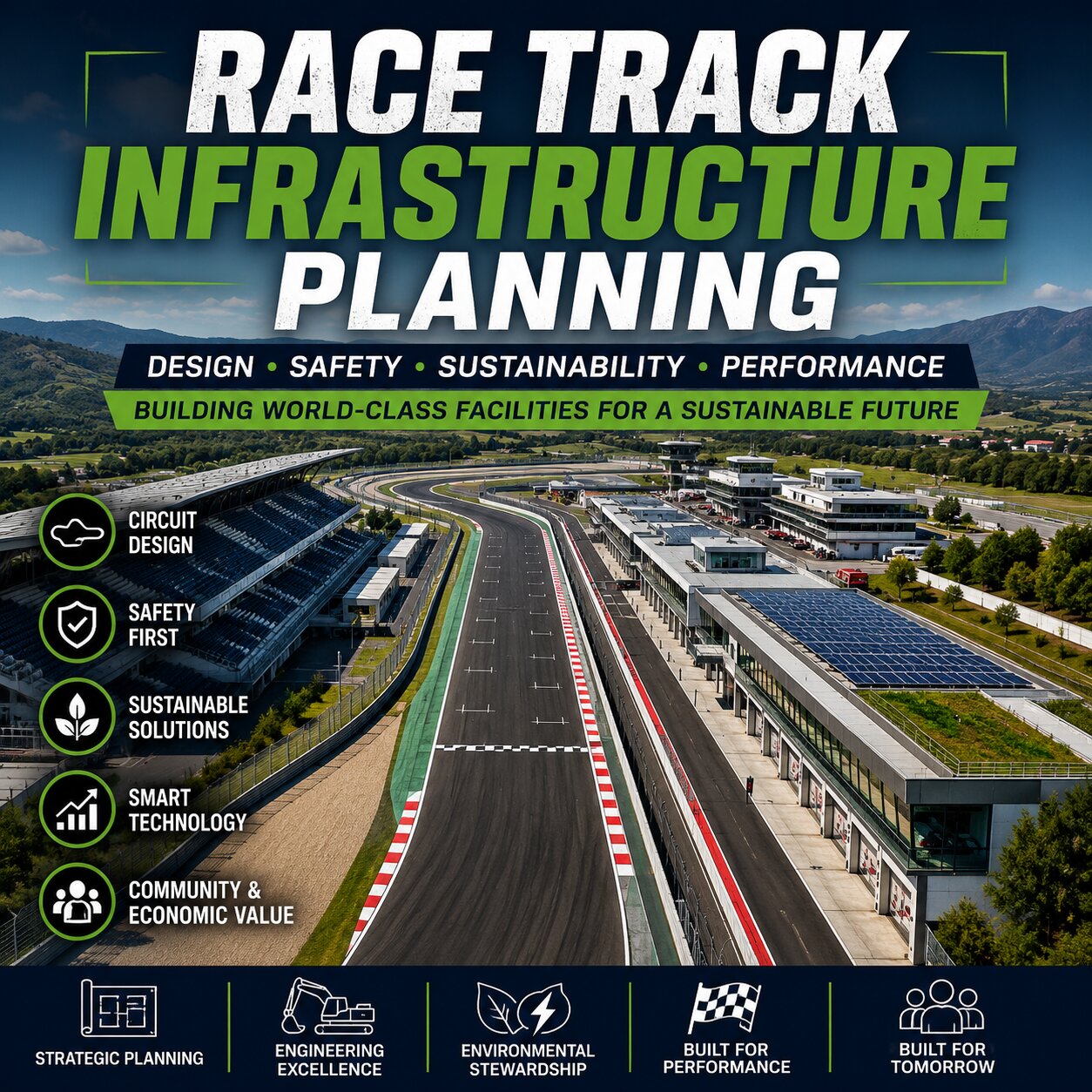
Race Track Infrastructure Planning is far more than laying asphalt and painting grid lines. Modern motorsport venues are complex facilities that combine engineering, architecture, project management, environmental responsibility and spectator experience into a single integrated development. Whether designing a permanent racing circuit or upgrading an existing venue, careful planning ensures that drivers, teams, officials, spectators and surrounding communities all benefit from a safe and sustainable motorsport environment.
Today’s race tracks are expected to serve multiple purposes beyond hosting racing events. Many facilities accommodate driver training, corporate events, public experiences, cycling, concerts, exhibitions and community activities throughout the year. This broader role means infrastructure planning must consider flexibility, operational efficiency and long-term financial sustainability from the earliest design stages.
As motorsport continues to evolve with new technologies and environmental expectations, Race Track Infrastructure Planning has become an increasingly multidisciplinary field that balances excitement with responsible development.
Establishing the Vision for a Modern Race Facility

Every successful race circuit begins with a clearly defined purpose. Some tracks are designed primarily for international motorsport competitions, while others focus on regional racing, motorcycle events, karting, testing facilities or driver education. Understanding these objectives influences every subsequent design decision.
Location selection is equally important. Engineers and planners evaluate land availability, terrain, accessibility, climate, surrounding communities and environmental sensitivity before construction begins. Existing transport infrastructure, accommodation, emergency services and tourism opportunities also influence the suitability of a site.
Long-term expansion should also be considered during the planning phase. A circuit that initially hosts national events may later aspire to international competition, requiring additional pit facilities, hospitality suites or spectator infrastructure. Planning for future growth reduces costly redevelopment later.
Ultimately, establishing a clear vision provides the foundation upon which every aspect of Race Track Infrastructure Planning is built.
Designing the Circuit Layout

The racing circuit itself is naturally the centrepiece of any motorsport facility. However, designing an exciting layout requires balancing competitive racing with driver safety and operational practicality.
Track designers carefully consider corner combinations, elevation changes, overtaking opportunities, braking zones and average speeds. The objective is to create a circuit that challenges competitors while remaining enjoyable for spectators and television audiences.
Surface quality also plays a critical role. High-quality pavement construction ensures consistent grip, durability and drainage while reducing long-term maintenance requirements. Drainage systems are particularly important to minimise standing water during heavy rainfall.
Modern circuit design is heavily influenced by international safety standards, ensuring runoff areas, barriers and marshal access points are incorporated from the beginning rather than added later.
Supporting Infrastructure Beyond the Track
A successful motorsport venue depends on far more than the racing surface. Supporting infrastructure determines how efficiently events can operate and how comfortably visitors experience the venue.
Key infrastructure typically includes:
- Pit lane and garages
- Race control and timing facilities
- Medical and emergency response centres
- Spectator grandstands and viewing areas
- Hospitality suites and media centres
- Internal road networks and parking
- Utility services including electricity, water and communications
Each of these components must function together as an integrated system. For example, emergency vehicles require rapid access to every section of the circuit without disrupting race operations, while media facilities need reliable communications infrastructure capable of supporting international broadcasting.
Good Race Track Infrastructure Planning ensures these operational requirements are addressed before construction begins.
Prioritising Safety Throughout the Facility

Safety remains the highest priority in motorsport infrastructure planning. Advances in circuit design have significantly reduced the risks faced by drivers, officials and spectators over the past several decades.
Barrier systems continue to evolve through improved energy absorption technologies, while runoff areas provide additional space for vehicles to decelerate after leaving the racing surface. Gravel traps, asphalt runoff zones and tyre barriers are selected according to the characteristics of each section of the circuit.
Emergency planning extends beyond the track itself. Medical centres require appropriate equipment, ambulance access and helicopter landing facilities where necessary. Fire response systems, evacuation procedures and communication networks must all be carefully coordinated.
Spectator safety is equally important. Crowd management, secure fencing, emergency exits and accessible facilities all contribute to creating a venue capable of hosting major international events.
Sustainability in Race Track Infrastructure Planning
Modern race circuits increasingly incorporate sustainability into both construction and ongoing operations. Environmental responsibility is no longer viewed as an optional feature but as a core planning objective.
Renewable energy systems such as solar installations can reduce operational costs while lowering emissions. Rainwater harvesting supports landscape irrigation and facility maintenance, while efficient lighting systems minimise electricity consumption.
Construction materials also influence environmental performance. Recycled asphalt, sustainable concrete solutions and locally sourced materials may reduce the overall environmental footprint of a development.
Biodiversity management has become another important consideration. Many modern circuits include habitat conservation programmes, indigenous landscaping and responsible stormwater management to minimise impacts on surrounding ecosystems.
These initiatives demonstrate how Race Track Infrastructure Planning can contribute positively to environmental stewardship without compromising motorsport performance.
Technology Is Transforming Modern Race Circuits
Digital technology now plays a vital role in both circuit operations and visitor experiences. Advanced fibre networks, wireless communications and integrated monitoring systems improve event management while supporting broadcasters, teams and officials.
Artificial intelligence and data analytics increasingly assist with predictive maintenance, helping operators identify infrastructure issues before they affect events. Smart sensors can monitor pavement conditions, utilities and environmental performance in real time.
For spectators, mobile applications, digital ticketing, interactive displays and improved connectivity enhance the overall race weekend experience. These technologies also provide valuable operational data that helps venue managers continuously improve services.
As autonomous systems, electric racing and connected vehicles become more common, race track infrastructure will continue adapting to support emerging technologies.
Delivering Long-Term Value Through Strategic Planning
One of the greatest challenges facing modern circuits is maintaining financial sustainability throughout the year. Facilities that operate only during major race weekends often struggle to generate sufficient revenue to justify their infrastructure investments.
Successful venues therefore diversify their activities by hosting corporate functions, exhibitions, concerts, driver training programmes, manufacturer testing, cycling events and community initiatives. Flexible infrastructure allows multiple event types to operate efficiently without compromising the circuit’s primary motorsport purpose.
This broader operational approach strengthens local tourism, creates employment opportunities and increases the economic contribution of the facility to surrounding communities.
For project managers, engineers and venue operators alike, Race Track Infrastructure Planning is ultimately about creating an adaptable asset capable of delivering value for decades.
Building the Future of Motorsport Facilities
As motorsport embraces electrification, digital transformation and stronger sustainability objectives, the role of Race Track Infrastructure Planning will continue expanding. Tomorrow’s race circuits must balance world-class competition with environmental responsibility, community engagement and commercial resilience.
The most successful facilities will not simply provide exciting racing. They will become multi-purpose destinations that support innovation, tourism, education and year-round economic activity.
Careful planning today ensures race tracks remain safe, efficient and relevant well into the future, creating facilities that serve competitors, fans and communities for generations to come.