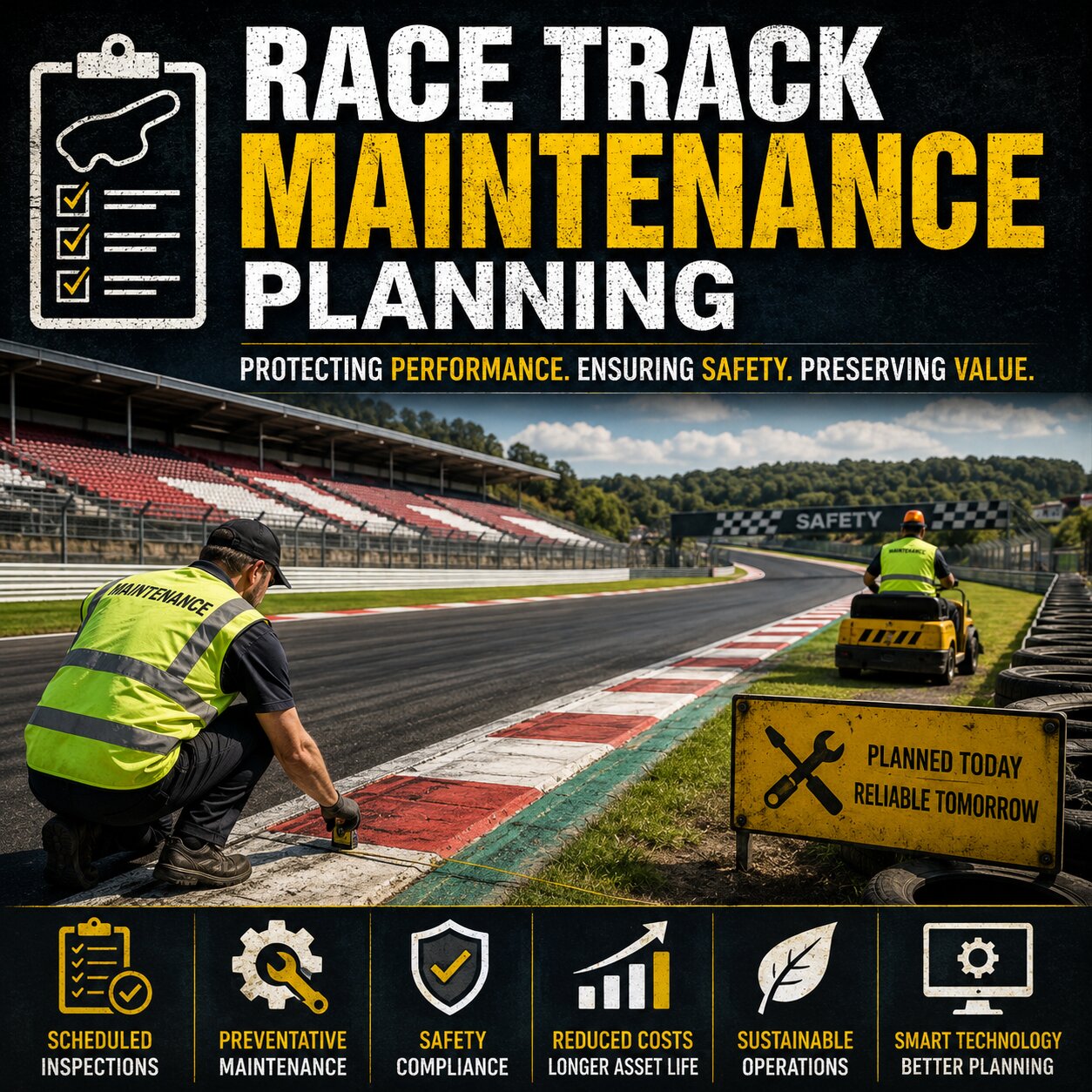
Every successful race circuit relies on more than exciting events and world-class facilities. Behind every smooth racing surface, functioning safety barrier, and pristine grandstand is a carefully developed race track maintenance planning strategy that keeps the venue operating at the highest possible standard.
Whether managing a Formula 1 circuit, a regional motorsport venue, or a multi-purpose racing complex, proactive maintenance planning reduces operational risks, extends asset life, improves safety, and protects the significant investment made in race track infrastructure. Rather than reacting to failures, modern facilities focus on scheduled inspections, preventative maintenance, and long-term asset management to ensure every event runs safely and efficiently.
Why Maintenance Planning Matters

A race track is subjected to extreme conditions throughout the year.
High-speed vehicles generate enormous forces on the racing surface, while weather, UV exposure, heavy rainfall, temperature fluctuations, and spectator traffic continually affect infrastructure.
Without proper race track maintenance planning, small defects can quickly develop into major issues that require costly repairs or disrupt scheduled events.
Effective planning allows facility managers to identify deterioration before it becomes a safety concern while minimising downtime and controlling maintenance budgets.
It also ensures compliance with motorsport governing body standards, protecting both competitors and spectators.
Developing a Comprehensive Maintenance Plan
Every maintenance programme should begin with a complete understanding of the facility’s assets.
This includes documenting:
- Racing surface and runoff areas
- Kerbs and painted markings
- Safety barriers and fencing
- Grandstands and hospitality facilities
- Pit lane and paddock infrastructure
- Lighting systems
- Drainage networks
- Buildings and utilities
- Landscaping and vegetation
Once assets have been identified, race track maintenance schedules can be created based on manufacturer recommendations, usage frequency, seasonal conditions, and operational priorities.
Modern Computerised Maintenance Management Systems (CMMS) can greatly simplify scheduling, inspections, reporting, and work order management.
Preventative Maintenance Reduces Costs

One of the primary goals of race track maintenance planning is reducing expensive emergency repairs.
Preventative maintenance focuses on identifying wear before failures occur.
Examples include resurfacing small cracks before they spread, servicing electrical systems before equipment fails during an event, inspecting barriers after every race weekend, and regularly cleaning drainage systems to prevent flooding.
Although preventative maintenance requires ongoing investment, it is significantly more cost-effective than major repairs or cancelled events caused by unexpected failures.
It also increases asset lifespan while improving operational reliability.
Maintaining the Racing Surface
The racing surface remains the most critical component of any circuit.
Routine inspections should monitor:
- Cracking and surface deterioration
- Rutting and uneven wear
- Loose debris
- Oil contamination
- Standing water
- Kerb damage
- Painted line visibility
Surface friction testing should also be conducted periodically to ensure consistent grip levels for competitors.
Any repairs should be completed well before scheduled race weekends to allow sufficient curing time and safety verification.
Safety Systems Require Continuous Inspection
Safety equipment cannot simply be installed and forgotten.
Barrier systems, tyre walls, TecPro barriers, catch fencing, marshal posts, emergency access routes, and medical facilities all require scheduled inspections throughout the year.
Following every motorsport event, damaged barriers and fencing should be assessed immediately.
Emergency communication systems, fire suppression equipment, and medical facilities should also undergo routine testing to ensure full operational readiness.
Proper documentation helps demonstrate compliance during governing body inspections.
Seasonal Maintenance Planning
Different times of the year present unique maintenance priorities.
During the off-season, facilities can undertake larger infrastructure projects, resurfacing work, grandstand repairs, and utility upgrades without affecting race calendars.
Before major events, maintenance teams typically focus on cosmetic improvements, vegetation control, cleaning, signage replacement, and detailed inspections.
Following race weekends, inspections identify any damage requiring immediate attention before the next scheduled activity.
This cyclical approach allows maintenance resources to be allocated efficiently throughout the year.
Technology is Transforming Maintenance
Modern race facilities increasingly rely on digital technologies to improve maintenance planning.
Drones can quickly inspect fencing, roofing, and large areas of infrastructure.
Sensors monitor structural movement, lighting performance, weather conditions, and utility consumption.
Asset management software provides real-time maintenance histories, inspection reports, budgeting information, and predictive maintenance schedules.
Artificial intelligence is also beginning to assist facility managers by analysing inspection data to predict failures before they occur.
These technologies improve decision-making while reducing operational costs.
Building a Sustainable Maintenance Strategy
Environmental sustainability is becoming an increasingly important part of race track maintenance planning.
Water-efficient irrigation systems, environmentally friendly cleaning products, recycled construction materials, LED lighting, renewable energy systems, and responsible waste management all contribute to more sustainable facility operations.
Preventative maintenance itself supports sustainability by extending infrastructure lifespan and reducing unnecessary material replacement.
Combining sustainability with long-term asset management creates facilities that are both environmentally responsible and financially resilient.
Investing in the Future of Every Circuit
Effective race track maintenance planning goes far beyond fixing damaged infrastructure. It creates a proactive framework that protects competitors, spectators, staff, and valuable assets while ensuring every event can operate safely and successfully.
By combining preventative maintenance, digital asset management, regular inspections, and sustainable practices, race track operators can maximise reliability, reduce operational costs, and preserve their facilities for decades to come.
As motorsport venues continue embracing smarter technologies and higher sustainability standards, maintenance planning will remain one of the most important foundations of successful race track management.