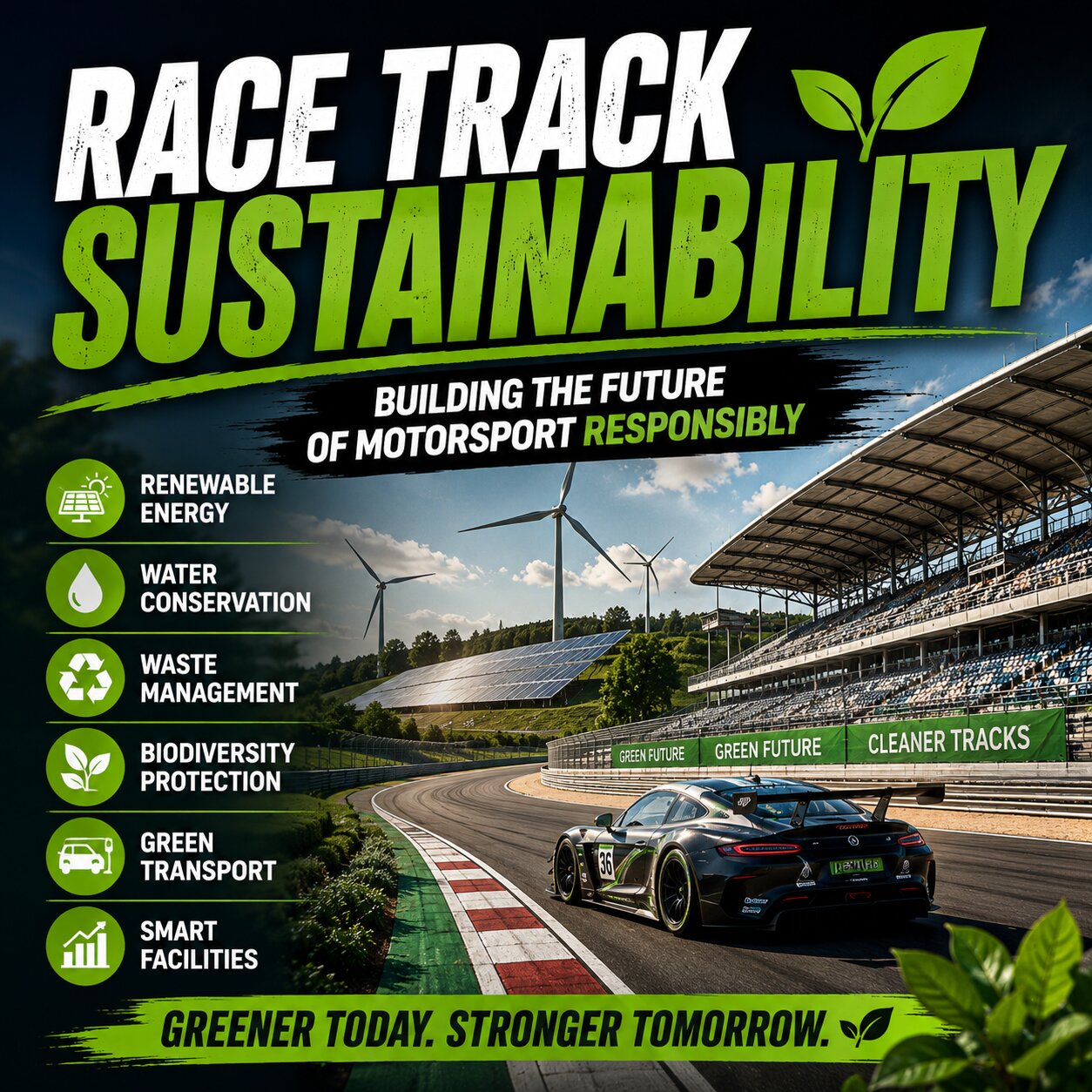
Race track sustainability is becoming one of the most important topics in modern motorsport. As racing organisations, circuit owners, event organisers, and governing bodies place greater emphasis on environmental responsibility, race tracks are evolving into facilities that balance thrilling competition with long-term sustainability.
From renewable energy and water conservation to waste management and biodiversity initiatives, today’s circuits are proving that motorsport and sustainability can work hand in hand.
Why Race Track Sustainability Matters

Race tracks are complex facilities that operate year-round. Beyond hosting races, many serve as testing venues, driver training centres, exhibition spaces, conference facilities, and entertainment destinations.
These activities consume significant amounts of energy and water while generating considerable waste.
Implementing race track sustainability practices helps facilities:
- Reduce environmental impact.
- Lower operating costs.
- Improve resource efficiency.
- Meet environmental regulations.
- Strengthen community relationships.
- Enhance long-term business resilience.
Sustainability is no longer simply about protecting the environment. It has become a strategic business decision.
Key Areas of Sustainable Race Track Management
Effective race track sustainability requires a holistic approach that considers every aspect of facility operations.
Renewable energy systems, including solar installations and battery storage, can reduce dependence on traditional electricity sources.
Water conservation measures such as rainwater harvesting, greywater recycling, and efficient irrigation help minimise water consumption, particularly in regions where water scarcity is a concern.
Waste reduction programmes encourage recycling, composting, and responsible disposal while reducing single-use plastics during major events.
Modern lighting systems, smart building controls, and energy-efficient facilities further reduce operational costs while lowering carbon emissions.
Even transport planning plays a role by encouraging public transport, shuttle services, cycling, and electric vehicle charging infrastructure.
Sustainability Extends Beyond the Circuit

The surrounding environment deserves just as much attention as the racing surface itself.
Many race tracks occupy large areas of land that can support native vegetation, wildlife habitats, and biodiversity projects.
Stormwater management systems help protect nearby rivers and wetlands from pollution, while careful landscaping reduces erosion and improves natural drainage.
Community engagement programmes, environmental education, and partnerships with local conservation organisations further demonstrate a facility’s commitment to responsible development.
Together, these initiatives transform race tracks into valuable community assets rather than isolated sporting venues.
- Renewable energy generation
- Water conservation systems
- Sustainable waste management
- Biodiversity protection
- Smart facility technologies
- Green transport initiatives
Race Track Sustainability Is Driving Motorsport Forward
As motorsport embraces innovation, race track sustainability is becoming an essential part of facility planning, operations, and long-term investment strategies.
Sustainable circuits reduce environmental impact while improving operational efficiency, enhancing visitor experiences, and supporting the future growth of motorsport. Whether developing new venues or upgrading existing facilities, integrating sustainability into every stage of the facility lifecycle ensures race tracks remain world-class destinations for generations to come.
At Sustainable Systems Tech, we will continue exploring how facility management, sustainability, technology, and project management are shaping the future of race track development.