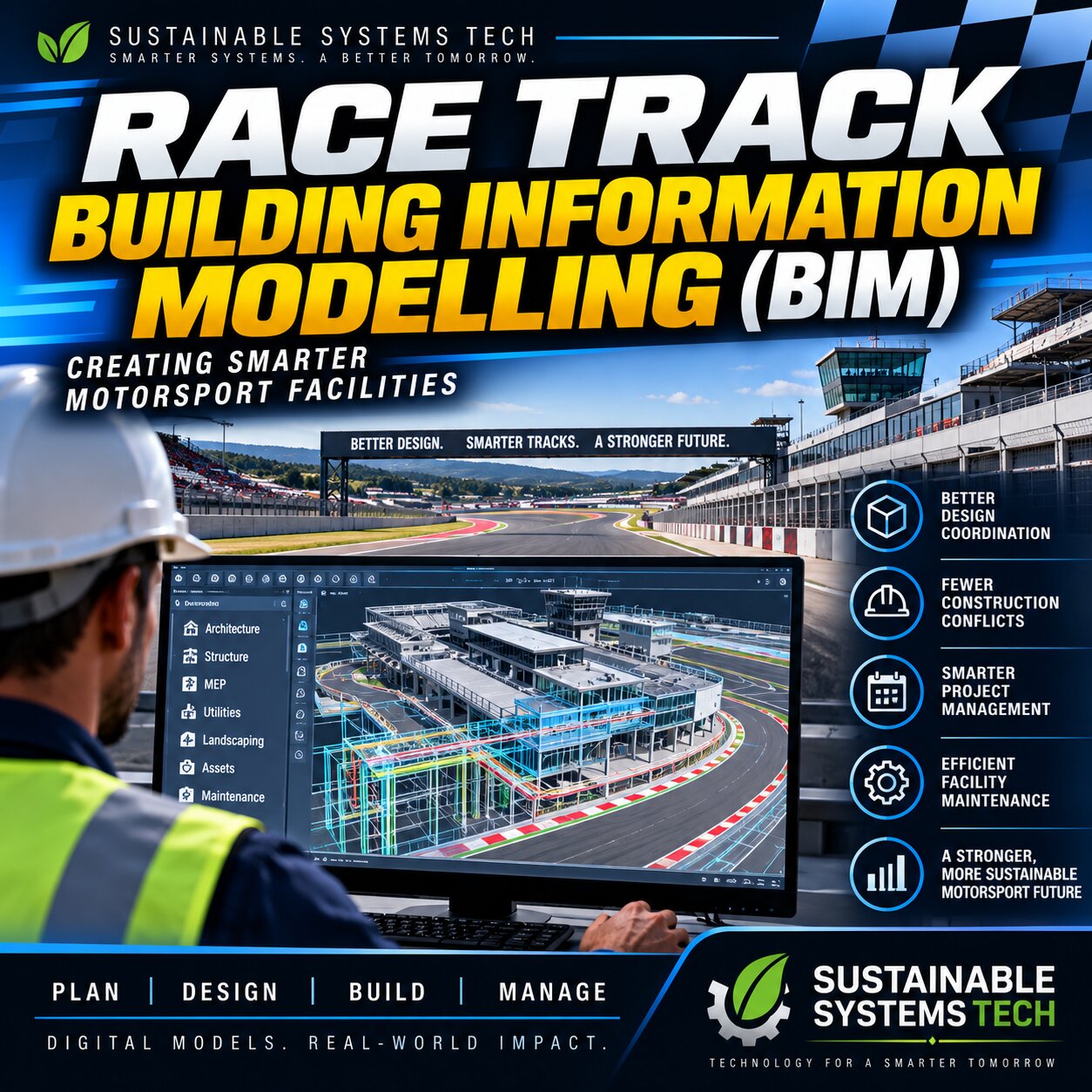
Modern race tracks are far more complex than a strip of asphalt surrounded by grandstands. They incorporate garages, hospitality areas, medical facilities, control centres, drainage networks, electrical infrastructure, spectator zones, communications systems and numerous other assets.
Race Track Building Information Modelling (BIM) provides a digital approach for planning, designing, constructing and managing these interconnected facilities.
Rather than relying on separate drawings and documents, BIM creates information-rich digital models that allow architects, engineers, contractors and facility managers to work with coordinated information throughout the race track’s lifecycle.
What Is Race Track Building Information Modelling?

Race Track Building Information Modelling combines three-dimensional models with data about the physical and functional characteristics of built assets.
For a motorsport venue, a BIM environment could contain information about everything from pit buildings and grandstands to electrical systems, access routes and underground utilities.
Importantly, BIM isn’t simply about producing an attractive 3D representation of a race track.
Individual components can contain useful information about dimensions, materials, specifications, maintenance requirements and relationships with surrounding infrastructure.
This creates a shared source of information that different teams can use when making decisions.
Designing Complex Motorsport Facilities
Race track developments involve numerous disciplines working simultaneously.
Architects may be designing hospitality facilities while structural engineers work on grandstands and civil engineers consider drainage, roads and track infrastructure.
Without effective coordination, clashes can occur.
For example, a ventilation duct might occupy the same space planned for electrical infrastructure. BIM tools can help teams identify these conflicts digitally before construction begins.
Potential BIM applications at race tracks include:
- Pit and paddock building design
- Grandstand and hospitality planning
- Mechanical and electrical coordination
- Drainage and utility mapping
- Emergency and service access planning
- Asset and maintenance information
Finding problems during the digital design stage can be considerably easier than discovering them after construction has started.
BIM During Race Track Construction

Once construction begins, the BIM model can continue supporting project teams.
Contractors can use coordinated models to understand where components should be installed, while project managers can compare construction progress against plans.
When BIM is connected with project scheduling, teams can also visualise how different phases of construction are expected to progress.
This can become particularly valuable when existing race tracks undergo upgrades.
Motorsport venues frequently have limited periods between events during which major construction work can take place. Better coordination can help teams plan these windows more effectively and reduce disruption to operations.
From Construction Model to Facility Management
The usefulness of Race Track Building Information Modelling doesn’t need to end when the contractors leave.
Information collected during design and construction can potentially become part of the venue’s long-term facility management system.
Facility teams could use digital asset information to locate equipment, review specifications and understand maintenance requirements.
Imagine selecting an air-conditioning unit inside the digital pit building and immediately accessing information about its model, installation date and maintenance requirements.
That transforms BIM from a construction tool into a potentially valuable operational resource.
BIM and Race Track Digital Twins
Race Track BIM also connects naturally with another technology increasingly being explored across infrastructure: digital twins.
While BIM generally provides structured information about the physical facility, a digital twin can potentially incorporate live operational information from sensors and other connected systems.
A BIM model may show where equipment is located and what it is. A digital twin could additionally indicate how that equipment is currently performing.
The technologies can therefore complement one another rather than compete.
Building a Better Understanding of the Race Track
Race tracks contain enormous amounts of infrastructure that spectators rarely notice.
Building Information Modelling provides a way to bring much of that information into a coordinated digital environment that can support planning, construction, maintenance and future upgrades.
As motorsport venues become smarter and increasingly connected, the value of having accurate digital information about their physical assets is likely to grow.
Race Track Building Information Modelling can consequently form part of the foundation for more efficient, sustainable and technologically advanced motorsport facilities.