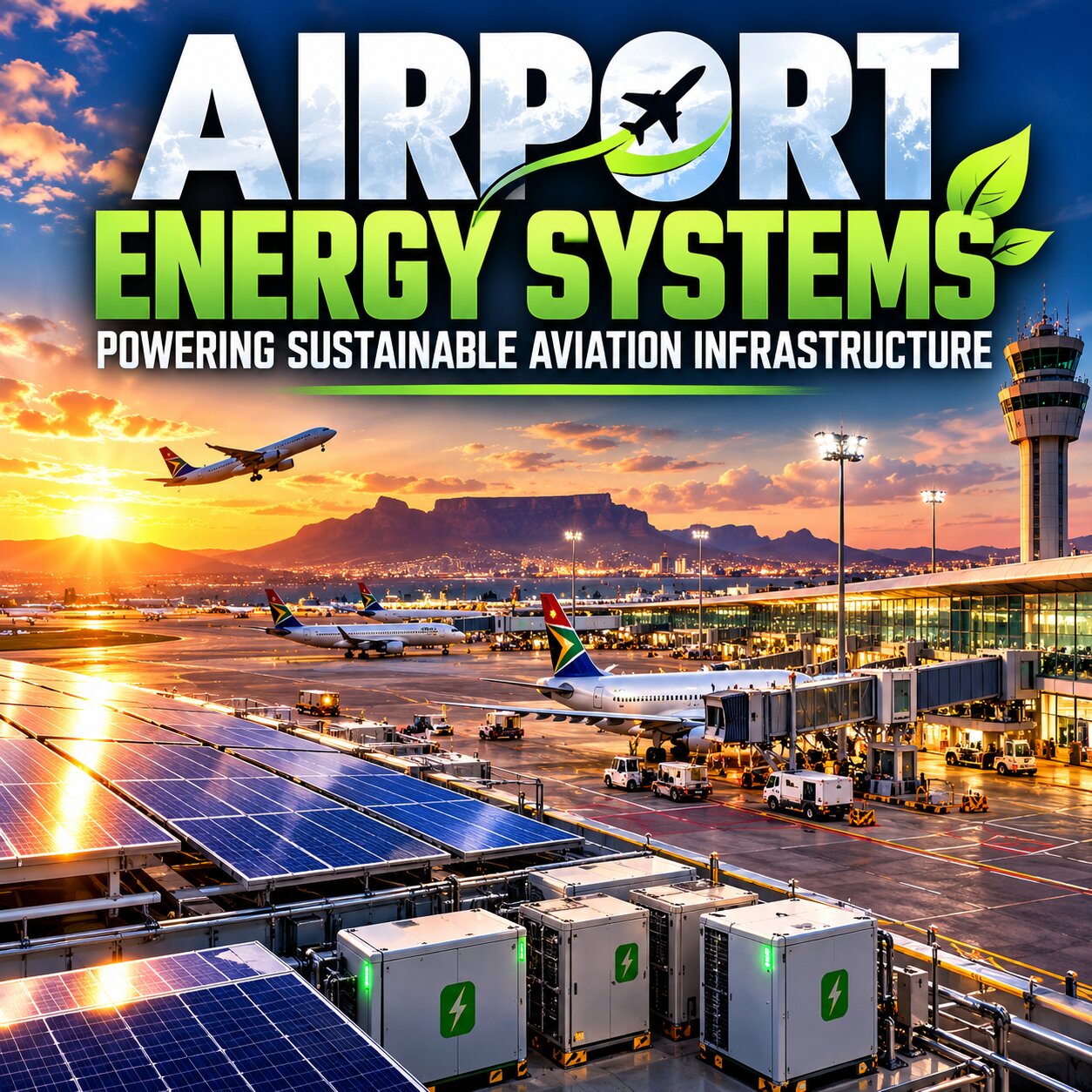
Airports never truly sleep. Even when passenger terminals become quieter overnight, essential systems continue operating behind the scenes. Runway lighting remains available, security systems stay active, communications equipment keeps running, refrigeration protects food and other goods, and enormous amounts of infrastructure remain ready for the next wave of passengers and aircraft.
Keeping all of this functioning requires substantial amounts of energy.
As airports modernise, airport energy systems are becoming an increasingly important part of sustainable infrastructure planning. Renewable generation, battery storage, intelligent energy management and more efficient equipment can help airports reduce their environmental impact while maintaining the reliability demanded by aviation.
For South Africa, where electricity reliability and energy costs remain important infrastructure considerations, developing resilient airport energy systems could provide benefits extending far beyond sustainability alone.
Why Airports Consume So Much Energy

An airport is effectively a small city combined with an enormous transportation facility.
Passenger terminals require lighting, heating, cooling, ventilation, escalators, lifts, baggage-handling equipment, security systems, digital displays and extensive information technology infrastructure.
Outside the terminal, additional electricity supports runway and taxiway lighting, navigation-related infrastructure, maintenance facilities, workshops, hangars, offices and cargo operations.
The energy requirements quickly accumulate.
Large international airports naturally consume considerably more energy than small regional facilities, but reducing unnecessary consumption can benefit airports of almost any size.
That makes energy efficiency one of the foundations of sustainable airport design.
Renewable Energy at Airports
Airports can present interesting opportunities for renewable-energy generation, particularly solar power.
Terminal buildings, parking structures, maintenance facilities and other airport properties can provide substantial roof areas suitable for photovoltaic installations. Where appropriate land is available and aviation safety requirements permit it, ground-mounted solar facilities may provide additional generating capacity.
South Africa’s solar resources make this particularly relevant locally.
However, installing solar panels is only one component of a complete airport energy strategy.
Renewable generation needs to be carefully integrated with the facility’s electrical network, operational requirements and backup systems. Airports must also consider factors such as glare, placement, maintenance access and any potential interaction with aviation operations.
Sustainability can never compromise safety.
Battery Storage and Energy Resilience

Battery energy storage systems could play an increasingly important role within future airport energy systems.
Solar generation naturally varies throughout the day, while airport electricity demand doesn’t necessarily follow the same pattern. Battery storage allows some excess electricity to be retained and used when required.
Storage can also contribute to resilience.
Airports contain critical infrastructure that cannot simply shut down whenever electricity from the wider grid becomes unavailable. Backup generation has therefore traditionally been essential.
Future airport energy systems could combine grid electricity, renewable generation, batteries and conventional backup power within a coordinated system.
The objective isn’t necessarily to depend on a single source of electricity. It is to create multiple layers of energy security.
Smarter Airport Energy Management
Generating cleaner electricity is important, but using electricity intelligently can be equally valuable.
Modern building and energy management systems can monitor consumption throughout airport facilities and identify where unnecessary energy is being used.
Lighting provides a straightforward example.
LED technology can dramatically reduce electricity requirements compared with older lighting systems, while intelligent controls can adjust illumination according to occupancy, daylight availability and operational requirements.
Heating, ventilation and air conditioning systems offer another major opportunity. Instead of treating an entire terminal as though every area has identical requirements, smart controls can respond to passenger volumes and conditions in individual zones.
Airport operators can also monitor:
- Terminal electricity consumption, HVAC demand, lighting, charging infrastructure, baggage systems, renewable generation, battery storage and other major electrical loads.
Collecting this information provides operators with a clearer understanding of where energy is being consumed and where improvements may deliver meaningful results.
Electrifying Ground Operations
Aircraft aren’t the only vehicles moving around airports.
Ground-support operations rely on baggage tractors, passenger buses, service vehicles, catering trucks, maintenance vehicles and numerous specialised machines.
Traditionally, many have relied on petrol or diesel engines.
Electrification creates an opportunity to reduce both fuel consumption and local emissions, particularly because many airport vehicles operate within relatively predictable areas and return regularly to designated facilities.
That makes charging easier to plan than it might be for vehicles travelling unpredictable routes across an entire country.
However, electrification also increases electricity demand.
Airport energy systems therefore need to evolve alongside electric ground fleets. Charging infrastructure, grid capacity and energy-management software must all be considered when planning the transition.
Designing Airport Microgrids
One of the most interesting developments in sustainable airport infrastructure is the potential use of microgrids.
A microgrid connects multiple energy resources within a defined facility. At an airport, this could potentially include solar generation, battery storage, the national electricity grid and backup generators.
Intelligent controls can determine how these resources work together.
During normal operations, renewable electricity might reduce dependence on grid power. Batteries could store excess generation or help manage periods of high demand. If the external grid experiences an interruption, selected critical systems could potentially continue operating using available local resources.
The precise design would depend heavily on the airport.
A major international hub has vastly different requirements from a small regional airport, meaning there is no universal airport energy solution.
Building More Sustainable South African Airports
South African airports operate within an energy environment that makes efficiency and resilience particularly valuable.
Reducing electricity consumption can lower operating costs, while local renewable generation can reduce dependence on external electricity supplies. Battery storage and intelligent management systems can further strengthen resilience when designed correctly.
There are also environmental advantages.
Cleaner electricity can contribute towards reducing the overall carbon footprint associated with airport operations, particularly when combined with efficient buildings, electric ground vehicles and other sustainable infrastructure initiatives.
The transition doesn’t need to happen through one enormous project.
Airports can progressively modernise lighting, improve HVAC efficiency, install renewable generation, introduce battery storage and electrify suitable vehicle fleets as infrastructure and budgets permit.
Powering the Airport of Tomorrow
The future airport will require far more than runways, terminals and aircraft.
It will need an intelligent network capable of generating, distributing, storing and managing energy efficiently while maintaining the reliability aviation demands.
Renewable electricity alone won’t create a sustainable airport. Neither will batteries, electric vehicles or smart building controls.
The real opportunity comes from connecting these technologies.
Well-designed airport energy systems can combine renewable generation, storage, efficient infrastructure, intelligent monitoring and resilient backup solutions into one coordinated network.
As airports become increasingly connected and electrified, energy infrastructure will become just as important to their future as the terminals and runways passengers can actually see.
For South Africa, developing smarter airport energy systems offers an opportunity to create aviation facilities that aren’t merely more sustainable, but also more efficient and resilient for the decades ahead.