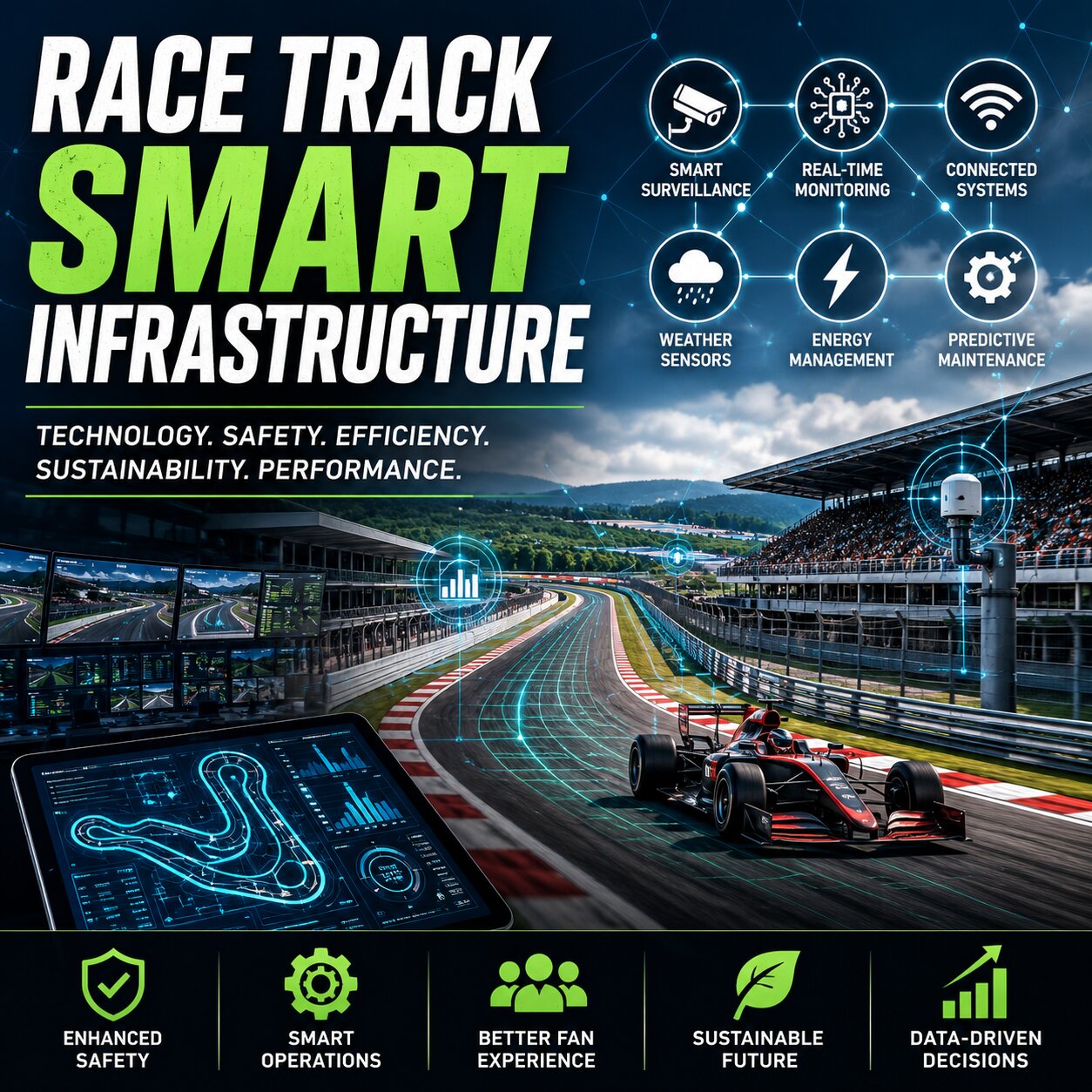
Modern motorsport venues are evolving far beyond simple racing facilities. Race track smart infrastructure combines digital technology, automation, connectivity, and real-time analytics to create circuits that are safer, more efficient, and more sustainable. From intelligent lighting and connected sensors to AI-powered traffic management, smart infrastructure is becoming an essential investment for race tracks around the world.
As motorsport continues embracing innovation, circuits that adopt intelligent systems are better positioned to improve the experience for competitors, officials, spectators, and event organisers alike.
What Is Race Track Smart Infrastructure?
Race track smart infrastructure refers to the integration of digital technologies throughout a motorsport venue to monitor, manage, and optimise operations. Instead of relying solely on manual inspections or fixed schedules, smart systems continuously collect data and automatically respond to changing conditions.
These technologies communicate through high-speed networks, allowing operators to monitor every aspect of the venue from a central control room.
Examples include:
- Smart sensors for track conditions, weather, and facility monitoring
- Connected CCTV and AI-assisted security systems
- Intelligent lighting and energy management
- Digital signage with live event updates
- Automated parking and traffic management
- Predictive maintenance for critical infrastructure
Together, these systems help reduce downtime while improving safety and operational efficiency.
Improving Safety Through Intelligent Systems
Safety remains the highest priority at every motorsport venue. Smart infrastructure provides officials with immediate access to critical information, allowing faster responses during incidents.
Sensors can detect changing weather conditions, temperature variations, or standing water on the circuit before they become serious hazards. AI-assisted cameras can identify incidents or unusual activity around the venue, while connected communication systems instantly notify marshals and emergency teams.
Even spectator management benefits from smart technology. Crowd monitoring helps event organisers identify congestion points, improve evacuation planning, and deploy security personnel where they are needed most.
Smarter Operations and Maintenance
Maintaining a race track requires significant resources. Race track smart infrastructure enables predictive maintenance by monitoring equipment performance in real time.
Instead of waiting for failures to occur, operators receive alerts when components begin showing signs of wear. This applies to lighting systems, electrical infrastructure, water pumps, grandstands, digital displays, and other essential facilities.
Data-driven maintenance reduces repair costs while improving reliability throughout the racing season.
Smart infrastructure also supports efficient event planning by analysing visitor movement, parking occupancy, concession demand, and utility consumption. These insights allow organisers to allocate staff and resources more effectively during future events.
Supporting Sustainable Motorsport
Smart infrastructure plays an important role in sustainability initiatives. Intelligent energy management automatically adjusts lighting and climate control based on occupancy, reducing unnecessary electricity consumption.
Water monitoring systems optimise irrigation and detect leaks early, while connected waste management solutions improve recycling and collection schedules.
As more circuits introduce renewable energy, battery storage, and electric vehicle charging stations, smart infrastructure becomes the digital backbone that coordinates these technologies into a single, efficient ecosystem.
Preparing Motorsport Venues for the Future
The future of motorsport depends on innovation both on and off the circuit. Race track smart infrastructure allows venues to become safer, more efficient, and more environmentally responsible while delivering a better experience for everyone involved.
As technologies such as artificial intelligence, digital twins, autonomous monitoring, and the Internet of Things continue to mature, race tracks will increasingly operate as fully connected intelligent facilities. Investing in smart infrastructure today helps ensure that tomorrow’s circuits remain competitive, resilient, and ready for the next generation of motorsport.