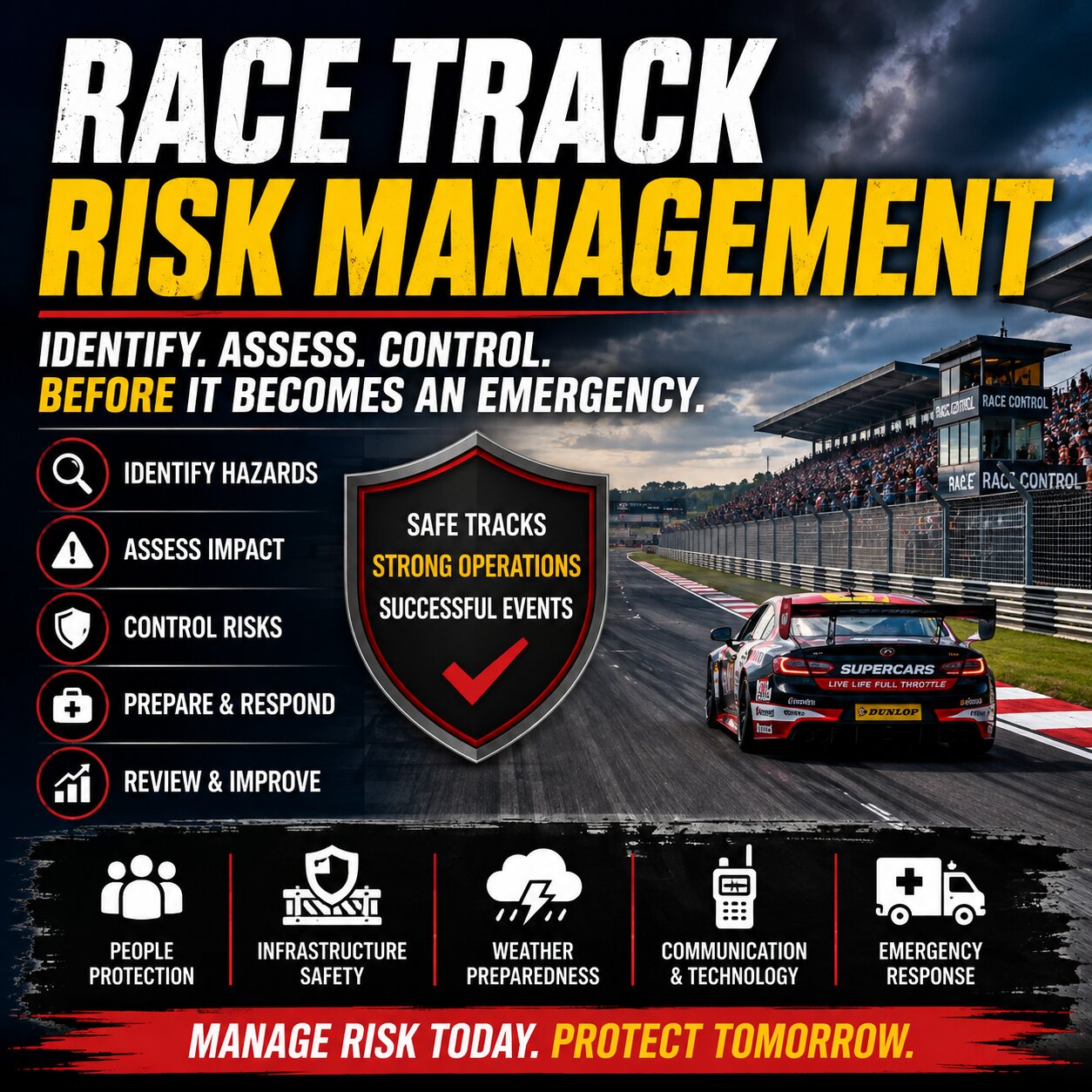
Motorsport will always involve risk. Cars and motorcycles travel at extreme speeds, thousands of spectators may gather around a circuit, temporary infrastructure appears for major events, and weather conditions can transform a perfectly manageable racing environment within minutes. The objective is therefore not to pretend that every danger can be eliminated, but to identify, assess and control those dangers as effectively as possible.
Race Track Risk Management provides the structured approach needed to achieve that objective. Instead of waiting for an accident, infrastructure failure or operational disruption to occur, circuit operators can identify vulnerabilities beforehand and determine how those risks should be controlled.
For modern motorsport venues, this process extends far beyond barriers and gravel traps. It involves the entire racing ecosystem, from competitors and marshals to spectators, infrastructure, technology and environmental conditions.
What Is Race Track Risk Management?
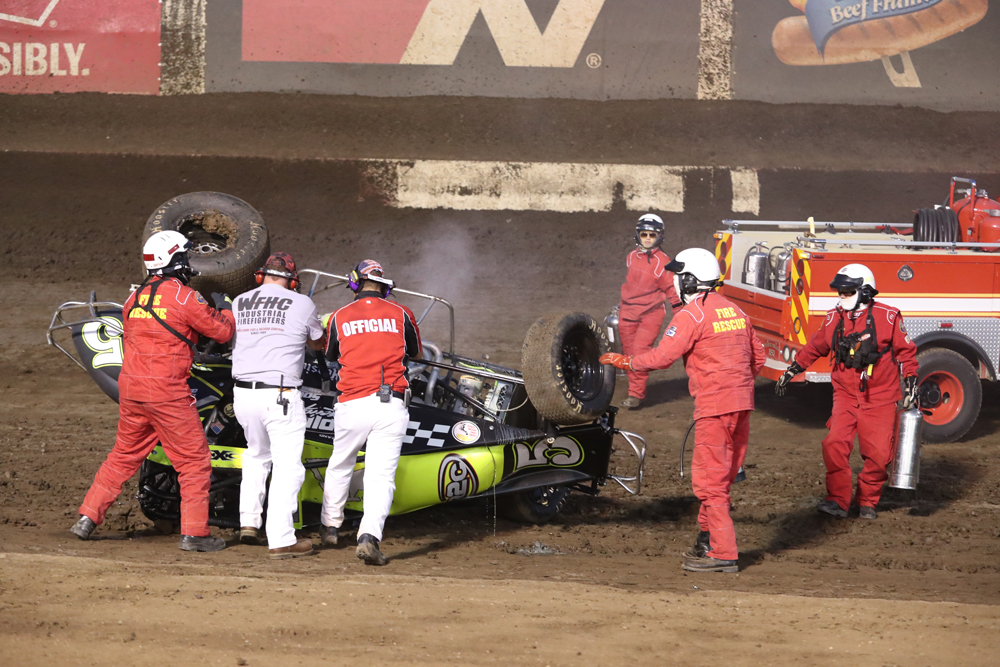
Race Track Risk Management is the systematic process of identifying hazards associated with a circuit, assessing their potential consequences and introducing measures to reduce either the likelihood or severity of an incident.
The process needs to consider both racing and non-racing activities. A circuit may have excellent safety barriers protecting competitors while simultaneously having inadequate pedestrian routes behind the grandstands. Likewise, an effective medical response system cannot compensate for poorly maintained electrical infrastructure that increases the possibility of a fire.
Risk management therefore requires operators to look at the venue as one interconnected system.
Potential risks can include:
- Vehicle accidents and debris entering spectator areas
- Barrier, fencing or structural failures
- Fires, fuel incidents and electrical hazards
- Severe weather, flooding and extreme temperatures
- Crowd congestion and uncontrolled pedestrian movement
- Communication or technology failures
- Access problems for emergency vehicles
- Temporary structure and hospitality facility failures
- Environmental contamination and hazardous spills
- Power, water or other utility interruptions
The objective of Race Track Risk Management is to understand how likely these events are, what their consequences could be and what controls are required before racing begins.
Risk Starts With Understanding the Circuit
Every racing circuit presents a different risk profile. A permanent international venue with large run-off areas will face different challenges from a temporary street circuit surrounded by buildings, public roads and temporary barriers.
Circuit characteristics therefore form an important starting point for Race Track Risk Management. Engineers and operational teams need to understand braking zones, expected vehicle speeds, elevation changes, track geometry, spectator locations and potential accident trajectories.
Historical incident information can strengthen this assessment. If vehicles repeatedly leave the circuit at a particular corner, for example, the issue deserves closer investigation even when previous accidents haven’t resulted in serious injuries.
Risk management asks an important question: what could happen next time?
That forward-looking approach allows circuit operators to respond before a known vulnerability becomes a major incident.
Infrastructure Needs Continuous Assessment

Motorsport infrastructure experiences significant physical and operational demands. Safety barriers can be struck repeatedly, kerbs experience constant loading, fencing is exposed to weather, and temporary facilities may be assembled and dismantled several times during a season.
Race Track Risk Management should therefore include continuous infrastructure assessment rather than relying exclusively on inspections immediately before major events.
Barriers, grandstands, bridges, access roads, drainage systems, electrical infrastructure, lighting and communications equipment all require appropriate inspection and maintenance schedules. Temporary infrastructure deserves equal attention because temporary does not mean unimportant.
A failed pedestrian bridge or hospitality structure could create consequences every bit as serious as an incident on the racing surface.
Digital asset management systems can help operators maintain records of inspections, repairs and component lifecycles. When this information is connected to digital models of the venue, engineering teams gain a clearer picture of where vulnerabilities exist and which assets require attention.
Weather Has Become an Increasingly Important Risk
Weather can affect virtually every component of a motorsport event.
Heavy rain may create standing water on the racing surface, overwhelm drainage systems or flood spectator areas. Strong winds can threaten temporary structures and signage, while extreme heat can increase medical risks for spectators, marshals and competitors.
Lightning introduces another category of danger entirely.
Modern Race Track Risk Management therefore needs access to reliable weather information and predefined operational responses. Event organisers shouldn’t be deciding what to do about an approaching storm only after lightning appears above the circuit.
Thresholds can be established beforehand for delaying sessions, evacuating particular areas or suspending operations. Drainage capacity, shelter locations and evacuation routes should similarly form part of planning.
The better the preparation, the less improvisation is required during an actual event.
People Are Part of the Risk Environment
Thousands of people moving through a motorsport venue create their own operational challenges.
Spectators need to travel between entrances, parking areas, grandstands, food vendors, toilets and entertainment zones. Employees, contractors, marshals, competitors and emergency personnel simultaneously need access to restricted operational areas.
Race Track Risk Management must account for how these different groups interact.
Poorly designed pedestrian routes can create bottlenecks. Uncontrolled crossings may bring spectators into conflict with service vehicles. Emergency access routes can become obstructed if parking and logistics aren’t properly controlled.
Technology can provide valuable information here. CCTV systems, pedestrian counters, access-control systems and digital crowd monitoring tools can help operators understand where congestion is developing and respond before conditions become dangerous.
However, technology needs to support good planning rather than replace it.
From Risk Management to Emergency Management
Risk management and emergency management are closely connected, but they aren’t the same thing.
Race Track Risk Management attempts to prevent incidents or reduce their potential impact. Emergency management determines what happens once an incident has occurred.
A fire-risk assessment, for example, might identify areas where fuel is stored and establish appropriate controls. An emergency response plan determines how firefighters, medical personnel and evacuation teams respond if those controls fail and a fire actually starts.
The strongest motorsport venues integrate both disciplines.
Every significant risk identified during assessment should encourage another question: if this happens despite our controls, are we prepared to respond?
That connection turns risk assessment from a paperwork exercise into an operational safety tool.
Digital Twins Can Strengthen Risk Planning
Digital technology is increasingly capable of helping circuit operators understand complicated interactions across their facilities.
A digital twin can create a virtual representation of the race track and associated infrastructure. When combined with operational information, the model can support Race Track Risk Management by allowing teams to visualise hazards, analyse movement and explore potential scenarios.
Operators could examine how spectators might evacuate from a particular grandstand, determine whether emergency vehicles can reach an incident during peak congestion or identify infrastructure located within vulnerable areas.
The greatest advantage is the ability to investigate scenarios without waiting for them to happen in the real world.
When connected with sensors, inspection data and other information sources, digital twins can also support ongoing asset monitoring and preventative maintenance.
Risk Management Is Never Finished
Perhaps the greatest mistake a motorsport facility can make is treating its risk assessment as a document that is completed once and then stored away.
Circuits change. Vehicles become faster. Spectator numbers increase. Infrastructure ages. New technologies are introduced, regulations evolve and weather patterns create different operational challenges.
Race Track Risk Management therefore needs to be a continuous process.
After every significant event, operators have an opportunity to review what happened. Near misses can be particularly valuable because they expose vulnerabilities without the consequences of a major accident.
If a crowd route became dangerously congested, a drainage system struggled during heavy rain or emergency vehicles experienced difficulty reaching part of the circuit, those observations should influence future planning.
Building Safer and More Resilient Racing Venues
Motorsport can never become completely risk-free, nor would anyone realistically expect it to. The challenge is ensuring that known hazards are understood and managed while the venue remains capable of responding when unexpected situations develop.
Effective Race Track Risk Management combines engineering, operations, technology and human decision-making. It examines what could go wrong, determines how serious the consequences could be and establishes measures to reduce those risks before thousands of people arrive for race weekend.
For modern race tracks, this isn’t simply about meeting safety requirements. It is about protecting competitors and spectators while preserving infrastructure, reducing operational disruption and strengthening the long-term resilience of the venue.
The best emergency is ultimately the one that never happens.
Through intelligent Race Track Risk Management, motorsport facilities can identify vulnerabilities earlier, invest resources where they matter most and create racing environments that are safer, smarter and better prepared for whatever happens next.