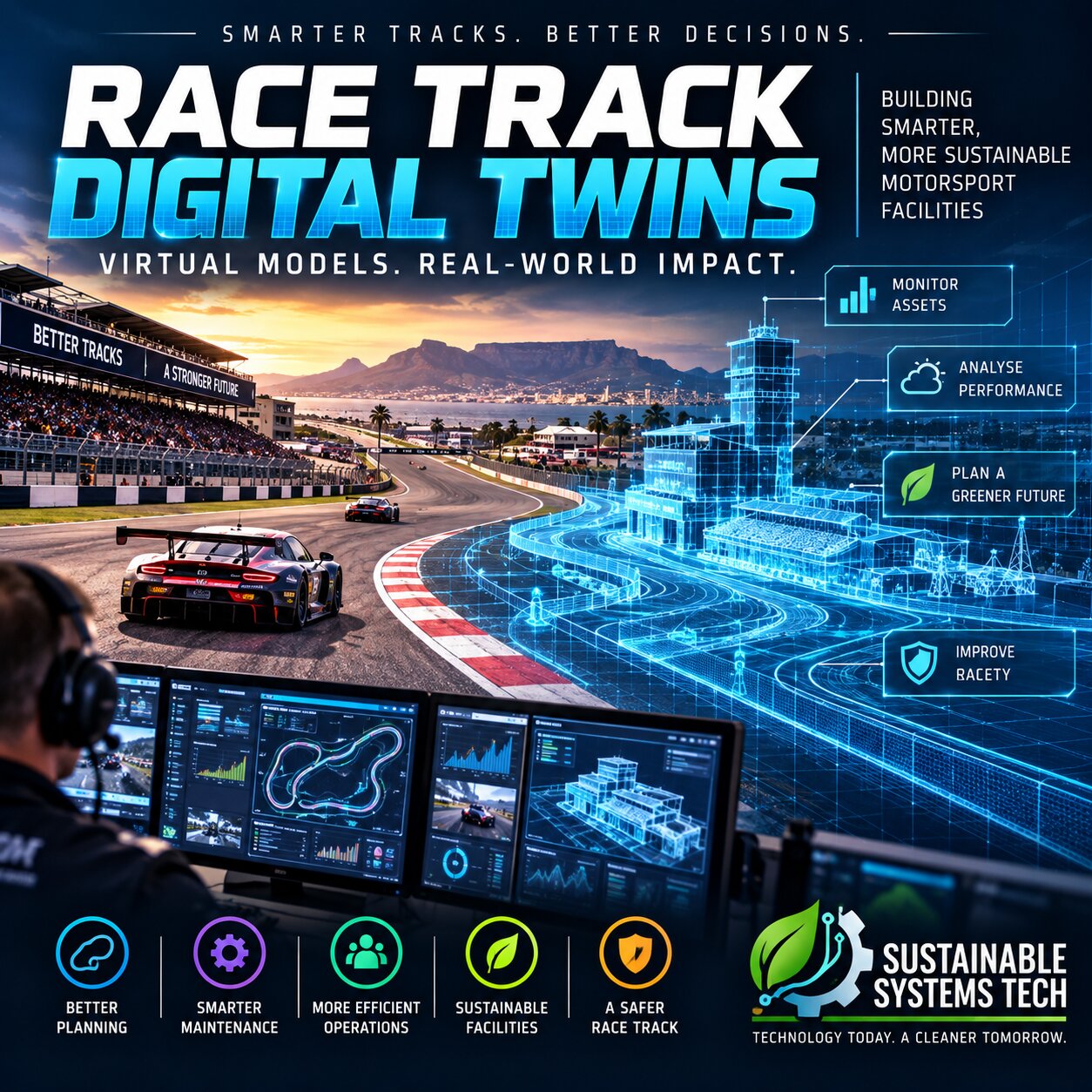
Modern race tracks are becoming increasingly connected, data-driven environments. Sensors monitor infrastructure, vehicles generate enormous quantities of information, and facility managers need increasingly sophisticated ways to understand how different systems interact. Race Track Digital Twins can bring these elements together by creating virtual representations of physical motorsport facilities.
A digital twin is more than a static 3D model. It can combine physical layouts with operational and real-time data to provide an evolving digital representation of a real-world asset or environment. Applied to motorsport facilities, the technology could encompass the circuit, buildings, utilities, safety infrastructure, traffic movements and environmental conditions.
Race Track Digital Twins therefore offer possibilities extending far beyond racing simulation. They can become tools for planning, monitoring, maintenance, sustainability and operational decision-making throughout the facility.
What Are Race Track Digital Twins?
Race Track Digital Twins are digital representations of physical race circuits and their associated infrastructure. Depending on the sophistication of the system, the twin may receive information from sensors, databases and other connected technologies deployed throughout the venue.
Unlike conventional architectural or engineering models, digital twins can continue evolving after construction. Changes made to the physical facility can be reflected digitally, while operational data provides information about how infrastructure actually performs.
The digital environment can potentially represent everything from track surfaces and barriers to grandstands, drainage systems, electrical infrastructure and buildings.
This gives operators a centralised way to visualise an increasingly complex motorsport facility.
Connecting Physical and Digital Infrastructure
Data is what transforms a detailed model into a useful digital twin.
Internet of Things sensors, cameras, weather stations, smart meters and building management systems can supply information from across a race track. The digital twin can then organise or visualise this information within the context of the physical facility.
Depending on the systems installed, Race Track Digital Twins could incorporate data relating to:
- Track surface and infrastructure conditions
- Electricity and water consumption
- Weather and environmental conditions
- Buildings and facility systems
- Vehicle and pedestrian movements
- Parking and traffic management
- Safety infrastructure and restricted areas
- Maintenance schedules and asset condition
Instead of examining these systems independently, operators gain an opportunity to understand how they interact across the venue.
Improving Race Track Maintenance

A circuit contains numerous assets requiring inspection and maintenance. Track surfaces, barriers, fencing, lighting, drainage, buildings and electrical systems all deteriorate differently depending on usage and environmental conditions.
Digital twins can support asset management by linking infrastructure information to specific locations within the virtual model. Maintenance teams could examine an asset’s history, inspection records and sensor information before physically travelling to it.
Predictive maintenance represents a particularly valuable possibility. Rather than waiting for equipment to fail, organisations can analyse performance information for signs of deterioration.
Race Track Digital Twins could consequently help facilities move from reactive maintenance towards more planned and data-informed approaches.
Supporting Event Planning and Operations
A race track can change dramatically between ordinary operating days and major events. Thousands of spectators, competitors, officials, vendors and employees may arrive within a relatively short period.
Digital twins provide environments in which organisers can model aspects of these operations before an event begins. Different layouts and scenarios could be assessed without disrupting the physical venue.
Traffic routes, pedestrian movement, temporary structures, hospitality areas and operational zones can potentially be visualised together.
Event teams may also use Race Track Digital Twins to improve communication. Instead of relying entirely on drawings, spreadsheets and separate systems, different departments can refer to a shared representation of the venue.
Digital Twins and Race Track Safety

Safety is fundamental to motorsport facility management, and virtual modelling provides opportunities to examine potential risks before they become real-world problems.
A digital twin can help planners study access routes, emergency vehicle movements, evacuation areas and infrastructure locations. Proposed changes to barriers, buildings or spectator areas could also be examined within the wider facility before implementation.
During events, connected systems may provide additional situational awareness. Information from cameras, sensors or other monitoring technologies can potentially be associated with specific areas of the virtual venue.
Digital twins should not replace established engineering assessments, safety standards or experienced personnel. Instead, they can provide another layer of information to support those responsible for making safety decisions.
Sustainability Through Better Data
Race tracks increasingly need to understand their consumption of electricity, water and other resources. Digital twins can help connect sustainability data with the infrastructure responsible for that consumption.
For example, operators might identify which buildings consume the most electricity, where water demand increases during events or how renewable energy systems perform across different conditions.
This information can support decisions about upgrades and operational changes. Instead of viewing sustainability only through facility-wide totals, managers may be able to investigate individual systems and locations.
Race Track Digital Twins can also assist with scenario modelling. Proposed solar installations, lighting upgrades, water-management improvements or building modifications could potentially be assessed digitally before significant resources are committed.
Challenges of Implementing Digital Twins
Creating a useful digital twin requires considerably more than purchasing software.
Facilities first need reliable information about their physical assets. Sensors and connected systems must then provide accurate data, while different technologies need to communicate effectively enough for the resulting information to remain useful.
Cybersecurity is another important consideration. As operational technology becomes increasingly connected, facilities need appropriate measures to protect systems and data from unauthorised access.
Cost, staff expertise and ongoing maintenance also matter. A digital twin that is not regularly updated can gradually become disconnected from the physical facility it is intended to represent.
Implementation therefore needs a clear purpose. Tracks should determine which operational problems they want the technology to solve before attempting to digitise everything at once.
Creating Smarter Race Tracks Through Digital Twins
Race Track Digital Twins demonstrate how motorsport infrastructure can become more intelligent without changing the fundamental purpose of the circuit.
The physical race track remains where cars compete, spectators gather and events take place. The digital twin creates another environment where operators can observe, analyse, test and plan what happens around it.
Combined with smart infrastructure, renewable energy, connected sensors and modern facility-management systems, digital twins could become an important component of future motorsport venues.
As race tracks generate more data and their infrastructure becomes increasingly connected, understanding that information will become just as important as collecting it.
Race Track Digital Twins provide one way of turning thousands of individual data points into something much more valuable: a virtual representation of the entire facility that can help operators understand what is happening today and make better-informed decisions about what happens next.