A modern motorsport venue needs far more than a good racing surface, grandstands and paddock. Successful circuits increasingly operate as year-round destinations where hospitality, retail, food, entertainment and business activities contribute to financial sustainability. Well-planned race track commercial facilities can transform a venue from an occasional event space into a diverse commercial ecosystem.
The challenge is integrating these facilities without compromising safety, operational efficiency or environmental objectives. Commercial development should complement the circuit while serving spectators, teams, businesses and the surrounding community.
For track owners and developers, this means considering commercial infrastructure during the earliest stages of master planning rather than adding it as an afterthought.
What Are Race Track Commercial Facilities?

Race track commercial facilities include the buildings, spaces and services designed to generate income or provide commercial activities beyond direct racing operations.
Some facilities primarily serve spectators during major events, while others can operate throughout the year. The strongest developments combine both approaches, creating revenue opportunities even when there are no cars circulating on the track.
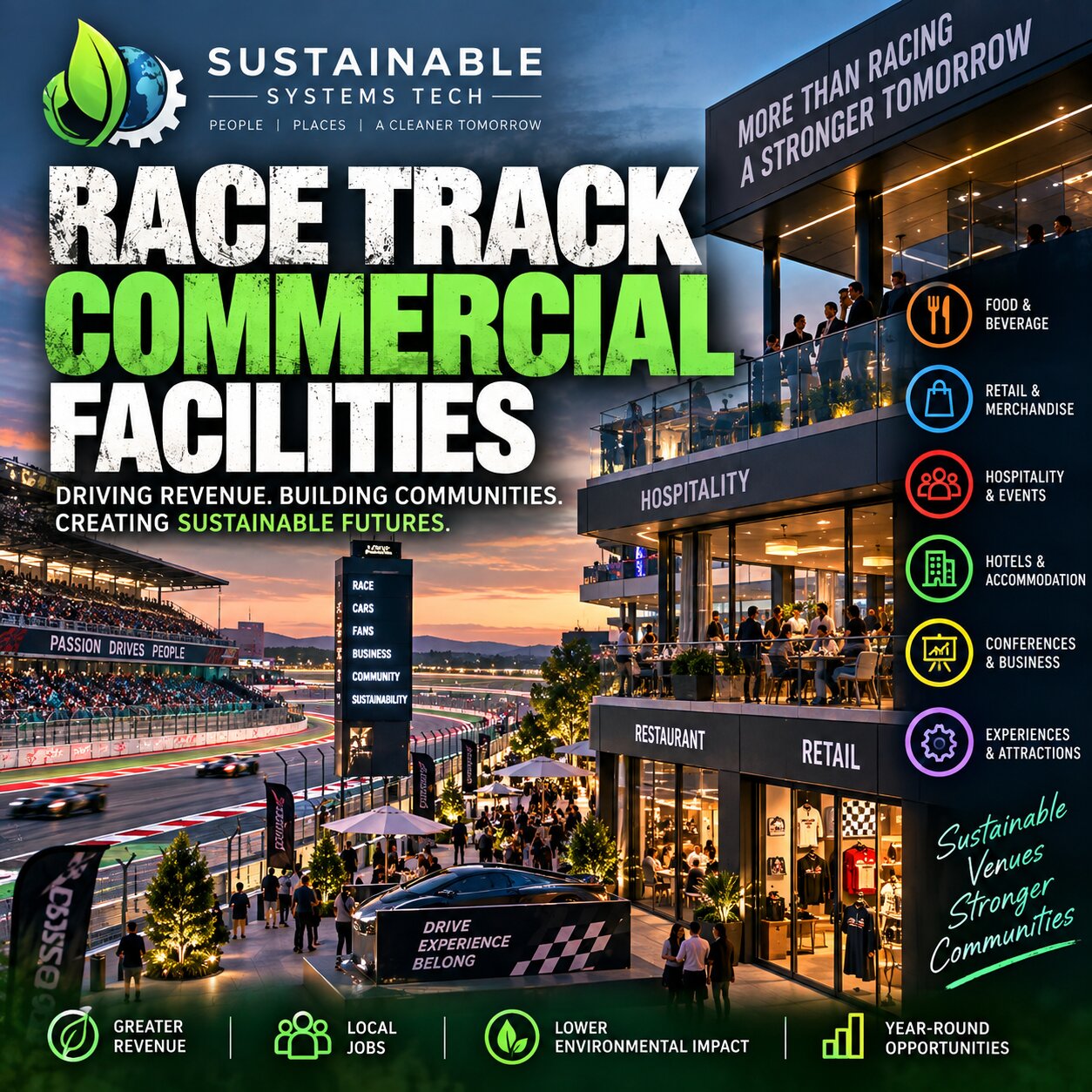
Typical race track commercial facilities can include:
- Restaurants, cafés and permanent food outlets
- Retail stores and motorsport merchandise shops
- VIP suites, hospitality lounges and corporate boxes
- Conference and meeting facilities
- Hotels and short-term accommodation
- Automotive dealerships and showrooms
- Driver training and experience centres
- Museums, exhibitions and visitor attractions
- Offices and commercial rental spaces
- Event venues for launches, exhibitions and private functions
The appropriate combination depends on the circuit’s location, visitor numbers, event calendar and wider development strategy.
Designing Commercial Areas Around Spectator Movement
Commercial facilities are most effective when positioned around natural pedestrian routes.
Spectators should encounter food, retail and entertainment spaces without those facilities obstructing access to grandstands, emergency routes or transport infrastructure. Planners can use pedestrian-flow modelling to identify locations where commercial areas will receive strong foot traffic without producing dangerous congestion.
Major gathering points near entrances, fan zones and grandstands provide obvious opportunities. However, distributing services around the venue can reduce pressure on individual areas.
Accessibility also needs consideration. Restaurants, shops, hospitality areas and other race track commercial facilities should accommodate visitors with different mobility requirements and provide suitable routes from parking and public transport areas.
Hospitality as a Major Commercial Asset
Corporate hospitality can represent an important source of income for professional motorsport venues.
Suites overlooking key sections of the circuit offer businesses premium environments for entertaining clients, rewarding employees or hosting partners. These spaces can command substantially different rates from ordinary spectator tickets while requiring comparatively little additional land.
Their usefulness should not end when the racing stops.
A hospitality suite designed with flexible furniture, suitable audiovisual systems and independent access can become a meeting room, conference facility or private event venue throughout the year.
This flexibility improves the commercial value of infrastructure that might otherwise remain unused between major events.
Restaurants, Retail and Permanent Visitor Attractions
Temporary food stalls remain useful during large racing weekends, but permanent establishments can help establish a circuit as a destination in its own right.
A restaurant overlooking the circuit, for example, can attract motorsport enthusiasts even on non-race days. Similarly, permanent merchandise stores, museums and interactive exhibitions can encourage tourism and provide additional reasons to visit.
Some race track commercial facilities may also serve nearby communities. Cafés, conference venues and restaurants positioned where they can operate independently from restricted circuit areas can remain accessible without opening the entire facility.
This separation can significantly improve year-round operating potential.
Sustainability Within Commercial Development
Commercial expansion should form part of the circuit’s wider environmental strategy.
Buildings can incorporate passive cooling, natural lighting, energy-efficient equipment and renewable-energy systems. Rooftop solar installations may provide electricity for hospitality, retail and administrative areas while reducing dependence on conventional energy sources.
Water efficiency is equally important. Low-flow fixtures, rainwater harvesting and appropriately designed landscaping can reduce consumption across commercial areas.
Waste management requires particular attention during large events. Restaurants and hospitality facilities generate substantial quantities of packaging, food waste and recyclable material. Dedicated sorting areas and clearly planned collection routes can make waste operations significantly more effective.
Creating Revenue Throughout the Year
One of the biggest weaknesses of traditional circuit economics is dependence on a limited number of major race weekends.
Diversified race track commercial facilities can reduce that vulnerability.
Conference centres can host corporate events. Restaurants can attract regular customers. Driver experience programmes can operate outside racing weekends. Automotive brands can use showrooms, workshops or testing facilities, while exhibition areas can accommodate launches and trade events.
Hotels located within or alongside motorsport developments can support racing teams during events but also serve business travellers and tourists throughout the year.
The objective is to make the venue commercially useful for considerably more than a handful of weekends.
Integrating Commercial and Motorsport Operations
Commercial activity should never interfere with core racing operations.
Delivery vehicles, restaurant suppliers, hotel guests and conference visitors need routes that do not conflict unnecessarily with team transporters, emergency vehicles or controlled paddock areas.
Service yards and loading zones should therefore be incorporated into the master plan.
Security zoning is equally important. Public commercial spaces may need to remain accessible while paddocks, garages, race control and technical facilities are restricted.
Careful planning allows both environments to operate simultaneously without weakening safety or security.
Supporting Local Businesses and Employment
Race track development can also create opportunities beyond businesses directly controlled by the venue.
Local food suppliers, accommodation providers, tourism operators and retailers may benefit from increased visitor activity. Circuits can strengthen these relationships by deliberately incorporating regional businesses into procurement and commercial programmes.
Permanent race track commercial facilities also create employment that extends beyond event-day staffing. Hospitality, administration, maintenance, retail and visitor attractions require people throughout the year.
This can strengthen the economic relationship between a circuit and its surrounding community, particularly when employment and procurement strategies favour regional participation.
Planning Race Track Commercial Facilities for Long-Term Value
Commercial infrastructure should ultimately support both the financial and operational sustainability of a motorsport venue.
Building shops, restaurants or hospitality suites simply because space is available does not guarantee success. Each facility needs a realistic market, appropriate access and a purpose beyond major race weekends wherever possible.
The strongest race track commercial facilities become part of a broader destination strategy. They complement racing while creating reasons for businesses, tourists, enthusiasts and local communities to interact with the venue throughout the year.
By integrating commercial development with transport, utilities, sustainability, security and circuit operations from the beginning, race track developers can create venues that are not merely places where races happen.
They can become active destinations capable of generating economic value long after the chequered flag falls.