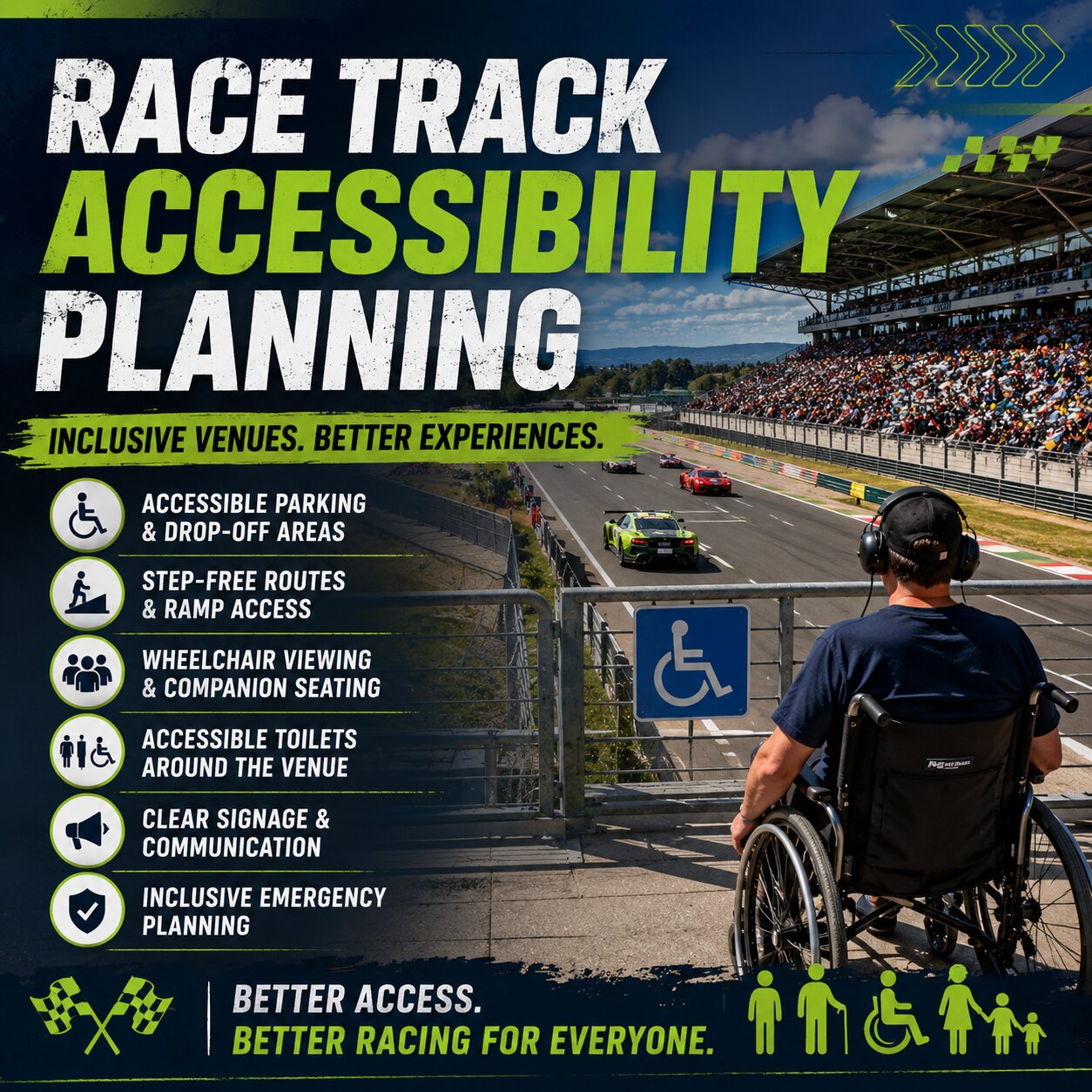
The roar of engines, the atmosphere of a packed grandstand and the excitement of wheel-to-wheel racing should be experiences that as many people as possible can enjoy. Effective Race Track Accessibility Planning helps motorsport venues accommodate spectators with different mobility, sensory and accessibility requirements while improving the overall movement of people around the facility.
Accessibility should not be treated as a handful of ramps added after everything else has been designed. Race circuits are complex environments containing grandstands, hospitality areas, paddocks, parking facilities, pedestrian routes, food vendors and emergency infrastructure. Planning how people reach and navigate these areas needs to form part of the wider venue-management strategy.
For permanent circuits and temporary motorsport events alike, thoughtful accessibility planning can create safer, more inclusive and ultimately more successful race weekends.
Race Track Accessibility Planning Starts Before the Entrance

A spectator’s experience begins long before reaching their seat. Race Track Accessibility Planning should therefore consider the complete journey from arrival at the venue to departure after the event.
Accessible parking needs to be positioned within reasonable travelling distance of entrances, while drop-off and collection areas should accommodate visitors who cannot comfortably travel long distances. Public transport connections, shuttle services and pedestrian routes also need consideration.
Simply designating accessible parking spaces isn’t enough if visitors then encounter gravel, steep gradients, kerbs or narrow pathways between their vehicles and the entrance.
Routes should provide suitable surfaces and sufficient space for wheelchairs and other mobility aids. Temporary cables, barriers, advertising structures and vendor installations also need careful positioning so they don’t unexpectedly obstruct accessible pathways during an event.
Good planning creates a continuous accessible route rather than isolated accessible facilities.
Designing Accessible Spectator Areas

Motorsport venues present a particular accessibility challenge because spectators may be distributed around kilometres of track.
Grandstands often involve stairs and significant elevation changes, while popular general-admission areas can be located on grassy embankments or uneven terrain. Race Track Accessibility Planning needs to identify where suitable viewing opportunities can be created without separating spectators with disabilities from the wider event atmosphere.
Dedicated wheelchair viewing areas may be necessary, but location matters. These areas should offer meaningful views of the racing rather than simply occupying whatever space remains available.
Companion seating should also be incorporated so visitors aren’t forced to experience an event separately from friends, family members or carers.
Where possible, venues should provide multiple accessible viewing locations. This gives spectators greater choice and helps prevent a single accessible area from becoming overcrowded during major events.
Accessible Facilities Throughout the Circuit
Getting spectators into a venue is only one part of the challenge. They need to remain comfortable and independent throughout what may be a very long race day.
Accessible toilets should therefore be distributed strategically rather than concentrated at one location. Food and beverage areas, merchandise stands and hospitality facilities should also provide appropriate access.
Important considerations for an accessibility strategy include:
- accessible parking, drop-off areas and shuttle services;
- step-free routes between major spectator facilities;
- wheelchair-friendly viewing platforms and companion spaces;
- accessible toilets located around the venue;
- clear directional and accessibility signage;
- suitable access to food, merchandise and hospitality areas;
- rest areas for spectators who cannot comfortably travel long distances;
- emergency procedures that account for different mobility and communication requirements.
These measures can benefit far more people than those with permanent disabilities. Older spectators, parents with pushchairs and people recovering from injuries may also find accessible infrastructure considerably easier to navigate.
Signage and Communication Matter Too

Physical access is only one element of Race Track Accessibility Planning. Visitors also need to understand where facilities are located and how to reach them.
Large motorsport venues can already be confusing for first-time visitors. Add tens of thousands of spectators, temporary barriers and restricted paddock areas, and navigation becomes considerably more difficult.
Clear signage should identify accessible entrances, toilets, viewing areas, lifts, ramps and transport services. Digital event maps can complement physical signs by allowing visitors to plan routes before arriving.
Accessibility information should ideally be published online before an event. Spectators can then determine where to park, which entrance to use and what facilities will be available rather than discovering limitations once they reach the circuit.
Communication considerations can extend to public-address systems, information screens and emergency notifications. Combining visual and audible communication methods can make critical information accessible to a wider audience.
Accessibility Must Be Part of Emergency Planning
Emergency management deserves particular attention at motorsport facilities.
Large crowds, temporary structures, restricted pathways and the inherent risks associated with high-speed motorsport make effective evacuation planning essential. Accessible viewing platforms and facilities cannot become areas where spectators are difficult to assist during an emergency.
Race Track Accessibility Planning should therefore integrate with the venue’s wider crowd and emergency management strategies.
Organisers need to understand how people with limited mobility can safely leave grandstands and viewing areas, particularly when lifts cannot be used. Staff should know where accessible facilities are located and what procedures apply if assistance is required.
Temporary motorsport venues face an additional challenge because layouts may change between events. Accessibility and evacuation routes need to be reassessed whenever barriers, grandstands, hospitality structures or spectator zones are repositioned.
Sustainable Infrastructure Can Improve Accessibility
Accessibility and sustainable infrastructure planning can complement one another surprisingly well.
Efficient pedestrian routes reduce unnecessary movement around a venue. Well-designed shuttle networks can decrease reliance on individual vehicles. Durable pathways and permanent accessible facilities can also reduce the need for temporary infrastructure to be installed repeatedly for major events.
For temporary circuits and occasional racing venues, modular ramps, viewing platforms and other reusable infrastructure can provide another option. Equipment can be designed for repeated deployment rather than discarded or replaced after individual events.
This makes Race Track Accessibility Planning relevant to sustainable venue management as well as social inclusion.
A sustainable venue shouldn’t only consider energy, water, waste and environmental impact. It should also consider whether the infrastructure being created genuinely serves the community using it.
Building Motorsport Venues for Everyone
Motorsport is ultimately built around people. Drivers and machines may provide the spectacle, but spectators create the atmosphere that transforms racing into an event.
Effective Race Track Accessibility Planning ensures that more of those spectators can participate comfortably, safely and independently.
From parking and pedestrian routes to viewing platforms, toilets, signage and emergency procedures, accessibility needs to run through the entire event-management process. Addressing these requirements during the planning stage is generally far more effective than trying to retrofit solutions once grandstands, barriers and temporary facilities are already in place.
For race circuits seeking to improve their infrastructure, accessibility represents both a responsibility and an opportunity. Better-designed venues can accommodate a broader audience while improving movement, communication and safety for everyone.
The best motorsport facilities aren’t simply designed around the racing line.
They’re designed around the people who come to experience it.