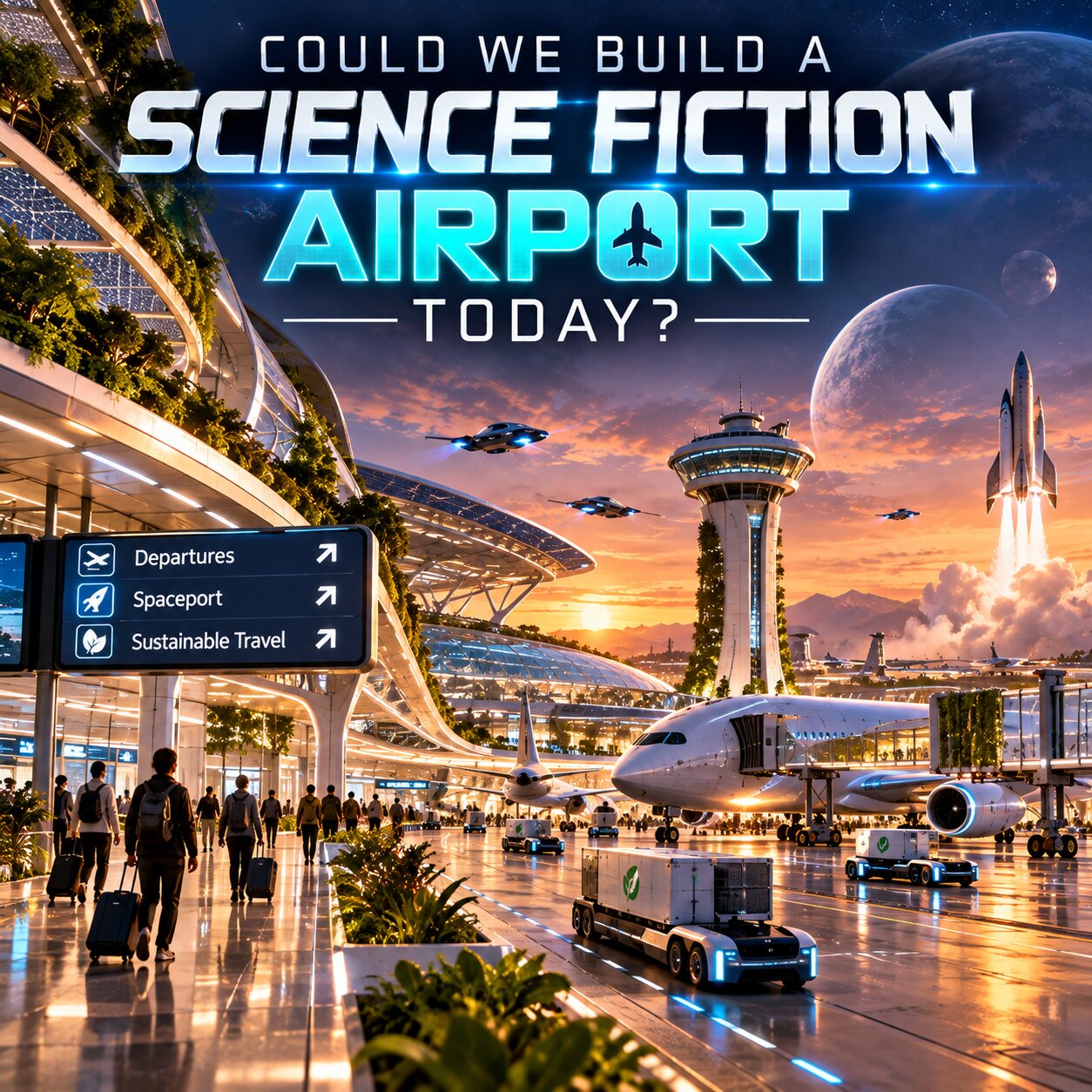
Imagine arriving at an airport where autonomous vehicles deliver luggage, robots inspect infrastructure, renewable energy powers the terminal and passengers move from entrance to aircraft with almost no physical documentation.
It sounds like the beginning of a science fiction story.
Yet many of the individual technologies required to create such an airport either exist already or are being developed. The truly futuristic airport may therefore be less about inventing impossible technology and more about integrating emerging systems into one enormous facility.
Energy would be a logical starting point.
Airports occupy vast areas, giving future facilities opportunities to integrate solar generation, battery storage, intelligent microgrids and energy-efficient buildings. Instead of simply consuming electricity from the surrounding grid, a highly advanced airport could generate and manage a significant proportion of its own energy.
Water, waste and environmental monitoring could also become increasingly automated.
The Intelligent Airport
Artificial intelligence could sit quietly behind much of the facility’s operation.
Sensors might monitor everything from terminal temperatures to runway conditions. Predictive maintenance systems could identify equipment likely to fail before a breakdown occurs, allowing technicians to intervene before operations are disrupted.
Autonomous ground vehicles could transport luggage and cargo between terminals and aircraft. Inspection robots or drones might examine difficult-to-reach infrastructure, while digital twins provide operators with virtual representations of buildings, energy systems and other assets.
Passenger movement could become similarly streamlined. Digital identification and biometric technologies could potentially reduce reliance on repeated document checks, although such systems would require careful attention to privacy, cybersecurity and regulation.
Then our science fiction airport can become more ambitious.
What if airports eventually serve aircraft and spacecraft?
Commercial spaceflight is still vastly different from conventional aviation, but future facilities might conceivably combine traditional terminals with infrastructure supporting suborbital passenger vehicles. A traveller could theoretically depart one continent, briefly leave the conventional atmosphere and arrive on another side of Earth dramatically faster than today’s long-haul flights.
A true science fiction spaceport would require specialised safety zones, energy systems, emergency services, communications infrastructure and completely different operational procedures.
Building such a facility today would be extraordinarily difficult and expensive. Building pieces of it, however, is entirely possible.
That may be how many futuristic facilities eventually emerge.
Instead of one revolutionary airport suddenly appearing, existing airports may gradually adopt smarter energy systems, autonomous equipment, advanced materials, AI-assisted operations and more sustainable infrastructure.
One upgrade follows another until yesterday’s science fiction quietly becomes standard engineering.
For infrastructure designers, that makes imagining the future more than an entertaining exercise. Sometimes the first stage of building tomorrow is simply asking what tomorrow could look like.
Perhaps your vision of tomorrow belongs in a novel instead. Celenic Earth Publications welcomes science fiction manuscripts from fiction authors for consideration. submit your sci fi book here.