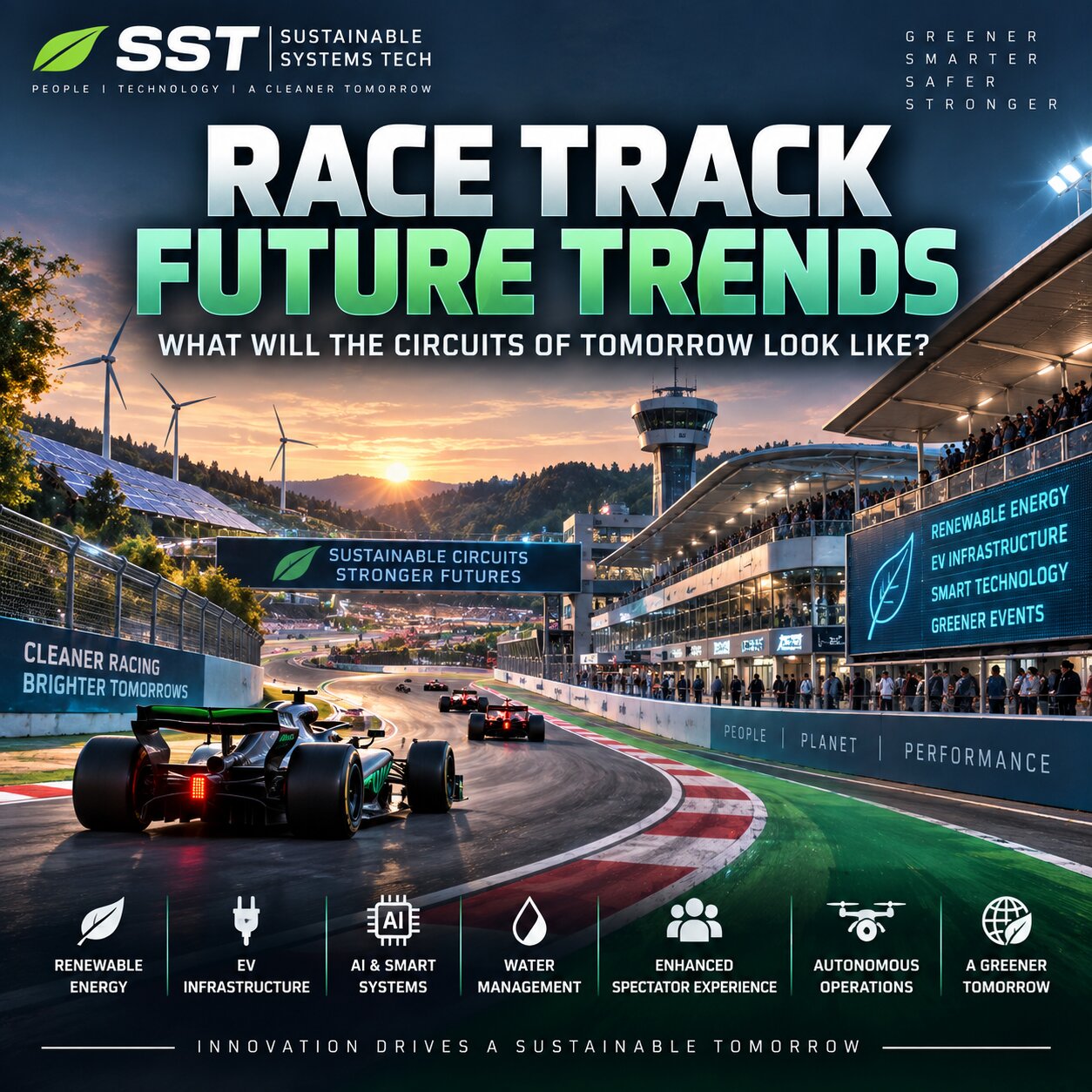
Motorsport circuits have evolved dramatically from the relatively simple tracks of the past. Modern facilities combine racing surfaces with sophisticated safety systems, communications networks, hospitality facilities, broadcasting technology and increasingly complex sustainability infrastructure. The next generation of circuits is likely to take that evolution considerably further.
Understanding race track future trends means looking beyond faster cars and improved racing surfaces. Future circuits may need to accommodate electric and alternative-fuel vehicles, generate more of their own energy, use artificial intelligence to manage facilities and provide entirely new experiences for spectators.
Here are some of the developments that could shape tomorrow’s race tracks.
Smarter Race Track Infrastructure

One of the most significant race track future trends will be greater integration between individual circuit systems.
Sensors installed around a facility could continuously monitor track conditions, weather, traffic, energy consumption and infrastructure performance. Instead of these systems operating independently, central management platforms could combine the information to provide circuit operators with a live picture of the entire venue.
Artificial intelligence may eventually help analyse this information.
For example, predictive systems could identify deteriorating infrastructure before failures occur. Maintenance teams could receive alerts when lighting equipment, drainage systems or electrical components show signs of unusual performance.
Smart infrastructure could consequently reduce downtime while helping circuits use their resources more efficiently.
Renewable Energy Becomes Part of the Circuit
Large motorsport facilities require considerable amounts of electricity, particularly during major race weekends.
Renewable generation therefore represents an important area for future development.
Solar panels can be incorporated into grandstands, hospitality buildings, car parks and other suitable structures. Depending on location, circuits may also investigate wind generation and other renewable technologies.
Battery storage could make these installations considerably more useful by allowing electricity generated during quieter periods to be stored for later use.
Future circuits may therefore operate more like small energy ecosystems, combining local generation, battery storage and intelligent energy-management systems.
Preparing for Electric Motorsport

Electrification is another major consideration when examining race track future trends.
As electric racing categories develop, circuits will need infrastructure capable of supporting large numbers of high-performance electric vehicles. That means more than simply installing several conventional charging stations.
Race teams may require extremely high-capacity charging infrastructure, dedicated electrical connections and carefully designed paddock energy systems.
Spectators are changing too.
As electric road vehicles become more common in many markets, race circuits could face increasing demand for EV charging in public parking areas. That creates another infrastructure challenge when thousands of visitors arrive at the same venue.
Water and Environmental Management
The circuit of the future may need to manage natural resources far more carefully.
Water harvesting systems could capture rainfall from grandstands, pit buildings and other large roof areas. This water may then be reused for landscaping, cleaning or other non-potable purposes.
Advanced drainage could simultaneously help circuits cope with increasingly severe weather events.
Environmental planning may also extend beyond the physical race track. Native vegetation, biodiversity corridors and carefully managed green areas can help integrate circuits into surrounding ecosystems.
Some facilities may eventually monitor environmental conditions with the same level of detail they currently apply to racing operations.
Digital Experiences for Spectators
The physical race may remain the centrepiece, but the spectator experience is becoming increasingly digital.
Future circuits could provide visitors with detailed live information through mobile applications and venue networks. Spectators might access timing information, onboard footage, driver statistics and interactive track maps from their seats.
Augmented reality could take this further.
Imagine pointing a smartphone towards a passing car and immediately seeing the driver’s name, current position, lap time and speed displayed over the live view.
Digital systems could also help visitors navigate large venues, locate facilities and identify less congested routes between different sections of the circuit.
Autonomous Systems Around the Venue
Autonomous technology could eventually become another important part of race track future trends.
Self-driving shuttle vehicles could transport spectators between parking areas, grandstands and entertainment zones. Autonomous maintenance equipment could handle certain routine tasks when the circuit is not being used.
Drones may also become increasingly valuable.
They could inspect barriers, fencing, roofs, solar installations and other infrastructure while providing circuit managers with detailed visual information without requiring personnel to access difficult locations.
Human supervision would remain important, particularly in safety-critical environments, but automation could make large motorsport venues easier to manage.
Designing Circuits for More Than Racing
Modern race tracks already host concerts, exhibitions, corporate events and driving experiences. Future facilities may be designed around this versatility from the beginning.
Grandstands and hospitality buildings could incorporate flexible spaces capable of serving multiple purposes throughout the year.
This makes economic as well as environmental sense.
A circuit used only for several major racing weekends each year leaves substantial infrastructure sitting idle. Multipurpose venues can generate additional revenue while making better use of existing buildings, transport links and utilities.
The distinction between race circuit, entertainment complex and technology hub may therefore become increasingly blurred.
The Race Track of Tomorrow
Many race track future trends are ultimately connected by one principle: integration.
Energy generation, environmental management, communications, spectator technology, transport and racing operations will increasingly function as parts of a connected system rather than isolated pieces of infrastructure.
Not every circuit will adopt these technologies at the same pace. Older venues face very different challenges from facilities designed and constructed from scratch.
Yet the direction is becoming increasingly clear.
Tomorrow’s motorsport circuit may not simply be a place where racing happens. It could become a smart, connected and increasingly self-sufficient facility capable of supporting new vehicle technologies while delivering better experiences for competitors, spectators and surrounding communities.
For engineers, sustainability specialists and motorsport organisations, the evolution of race tracks provides an opportunity to rethink what a modern sporting venue can become.