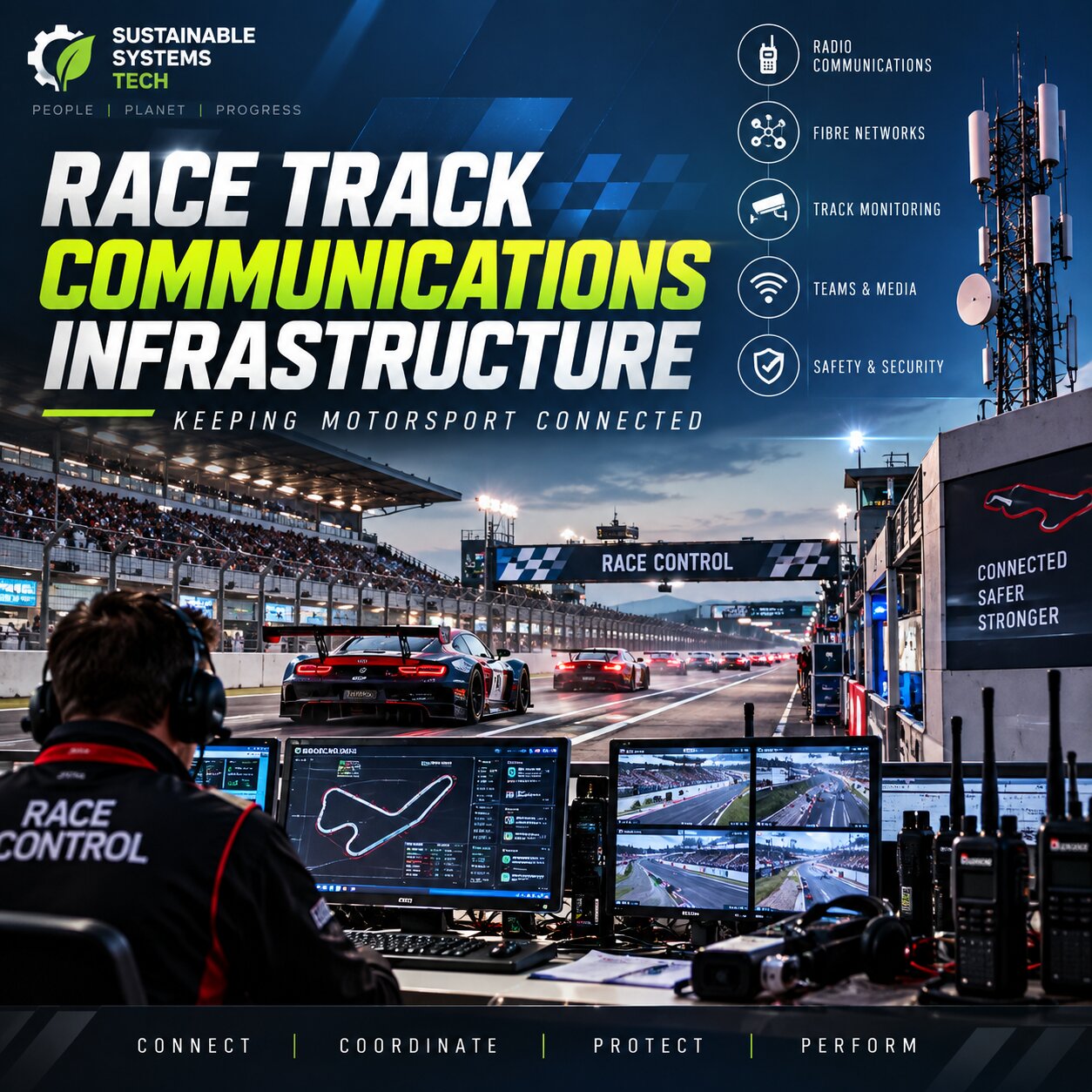
Modern motorsport depends on far more than fast cars, skilled drivers and well-designed circuits. Behind every race sits an extensive network of technology responsible for moving critical information between race control, marshals, teams, emergency personnel, broadcasters and spectators. Effective Race Track Communications Infrastructure is therefore an essential component of both circuit operations and safety.
As race venues become increasingly connected, communications planning must account for enormous quantities of data alongside traditional radio systems. Timing information, CCTV feeds, telemetry, digital flag panels, medical communications and broadcast services may all operate simultaneously.
Building resilient infrastructure ensures those systems continue functioning when they are needed most.
What Is Race Track Communications Infrastructure?

Race Track Communications Infrastructure refers to the physical and digital systems that allow information to travel reliably throughout a motorsport venue.
At its core, this usually involves a combination of fibre-optic networks, wired connections, radio communications, wireless networks, trackside equipment and central control systems.
Unlike communications infrastructure in many conventional facilities, race circuits can cover large areas. Equipment may need to connect race control with marshal posts, pit buildings, garages, medical centres, security positions and remote sections of the circuit.
The network must consequently provide both coverage and reliability across the entire operational environment.
Connecting Race Control and Trackside Operations
Race control functions as the information centre of a motorsport event. Officials need immediate access to what is happening around the circuit so that they can respond appropriately to incidents.
Trackside CCTV cameras, marshal communications, timing systems and other monitoring technologies can feed information back towards race control. Officials can then use these systems to coordinate responses and communicate instructions.
Radio remains particularly important because marshals and operational personnel need a practical way to communicate while working around the venue.
However, communications should not depend entirely on a single technology. Critical systems benefit from redundancy so that the loss of one connection does not leave sections of the circuit isolated.
Fibre Networks and High-Speed Data
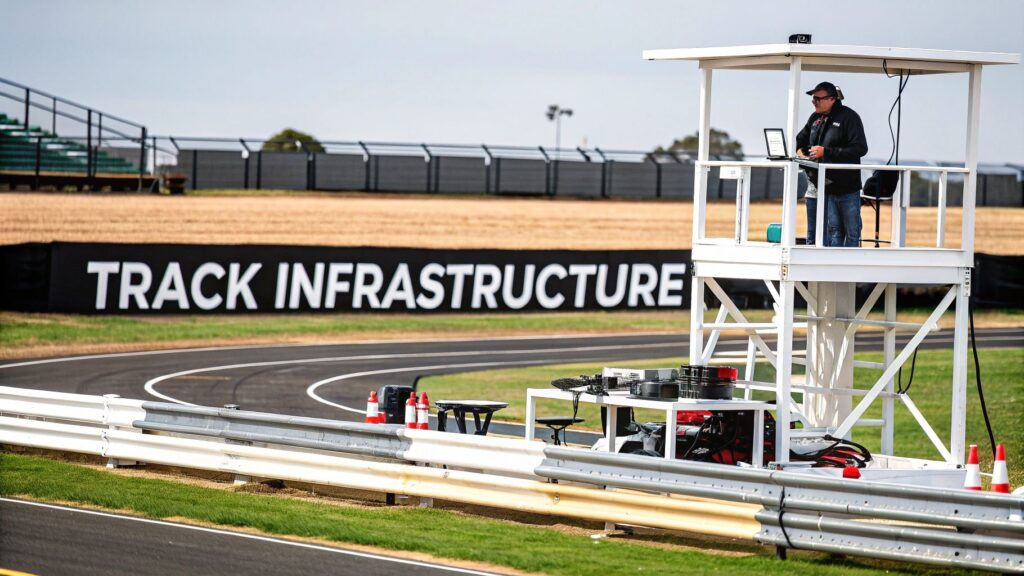
Modern circuits increasingly require infrastructure capable of carrying substantial amounts of data.
A well-designed fibre backbone can provide high-capacity connections between important locations around the facility. From there, local networking infrastructure can distribute connectivity to individual buildings, operational systems and trackside equipment.
Potential applications include:
- Race control and marshal communication systems
- CCTV and track monitoring feeds
- Timing, scoring and telemetry networks
- Pit, paddock and garage connectivity
- Broadcast and media infrastructure
- Digital signage and information systems
- Emergency and security communications
Network design should also consider future expansion. Installing sufficient capacity and strategically positioned connection points during initial infrastructure work can reduce the need for disruptive upgrades later.
Reliable Communications During Emergencies
Safety is one of the strongest reasons for investing in robust Race Track Communications Infrastructure.
When an accident occurs, race control may need to communicate immediately with marshals, medical teams, recovery crews and other officials. Delayed or interrupted information can complicate the response.
Emergency communications therefore require appropriate coverage throughout the venue, including locations where terrain, buildings or other structures could interfere with wireless signals.
Backup power is another important consideration. Communications equipment supporting critical operations should remain available during a local electricity failure or wider disruption.
Circuit planners can also identify alternative communication paths for essential services, helping operations continue if primary infrastructure becomes unavailable.
Supporting Teams, Media and Spectators
Race track connectivity extends beyond officials.
Professional teams increasingly depend on digital infrastructure throughout garages and pit areas. Media organisations require dependable connectivity to upload photographs, distribute reports and support live coverage. Broadcasters may need considerably greater capacity for transmitting video and audio.
Spectators have also changed the communications requirements of major venues. Thousands of visitors carrying connected devices can place substantial pressure on cellular and Wi-Fi networks.
Providing public connectivity therefore requires careful capacity planning rather than simply installing wireless access points throughout grandstands.
Operational networks should also remain appropriately separated from public-facing services to protect essential circuit systems.
Cybersecurity and Network Resilience
Greater connectivity creates additional risks.
Race circuits should treat cybersecurity as part of infrastructure planning rather than something added after networks have already been deployed. Access controls, network segmentation, monitoring and appropriate security policies can help prevent unauthorised users from reaching operational systems.
Physical protection matters too. Trackside cables, cabinets and network equipment may be exposed to weather, vibration, dust and accidental damage.
Resilience consequently involves both digital security and durable physical infrastructure.
Systems should also be documented clearly so technicians can locate faults and restore services quickly during an event.
Planning Communications Infrastructure for Future Circuits
Motorsport technology will continue evolving, and circuits designed today may operate for decades.
That makes scalability an important consideration when developing Race Track Communications Infrastructure. Fibre capacity, equipment locations, cable routes, power supplies and network architecture should accommodate technologies that may not yet be part of everyday race operations.
Infrastructure planning can also be coordinated with other circuit systems. Communications trenches and service routes, for example, may be considered alongside electrical distribution, drainage and other utilities during construction or major upgrades.
Taking an integrated approach can reduce unnecessary excavation and make future maintenance considerably easier.
Building a Connected and Resilient Race Track
Reliable Race Track Communications Infrastructure quietly supports almost every aspect of a modern motorsport event. From a marshal reporting an incident to race control receiving CCTV footage and broadcasters transmitting the action worldwide, information must move quickly and dependably.
The objective isn’t simply to provide more connectivity. Circuits need communications systems that remain available under demanding conditions, separate critical operations appropriately and provide sufficient capacity for future growth.
By incorporating communications into wider race track infrastructure planning, venue operators can create safer, more efficient and increasingly connected motorsport facilities.