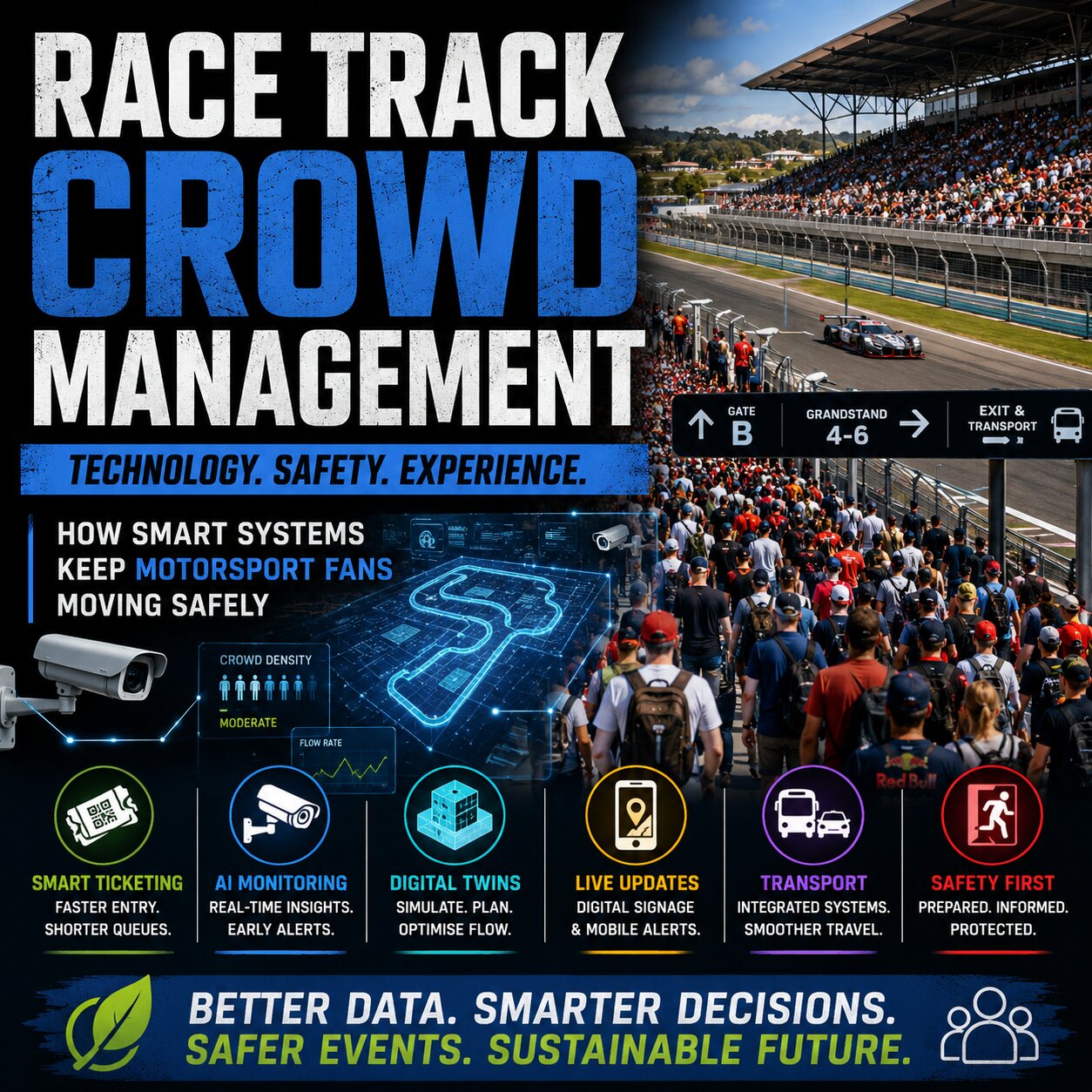
Modern motorsport venues are complex environments. While attention naturally falls on the racing machines travelling around the circuit, event organisers also need to manage thousands of spectators moving through entrances, grandstands, hospitality areas, food zones, parking facilities and transport hubs.
Effective Race Track Crowd Management therefore involves considerably more than employing security personnel and placing barriers around busy areas. Technology now allows circuit operators to understand how spectators are moving, identify congestion before it becomes dangerous and communicate with visitors in real time.
From smart ticketing and digital signage to artificial intelligence, digital twins and connected transport systems, modern race tracks are becoming increasingly intelligent environments.
Why Race Track Crowd Management Matters
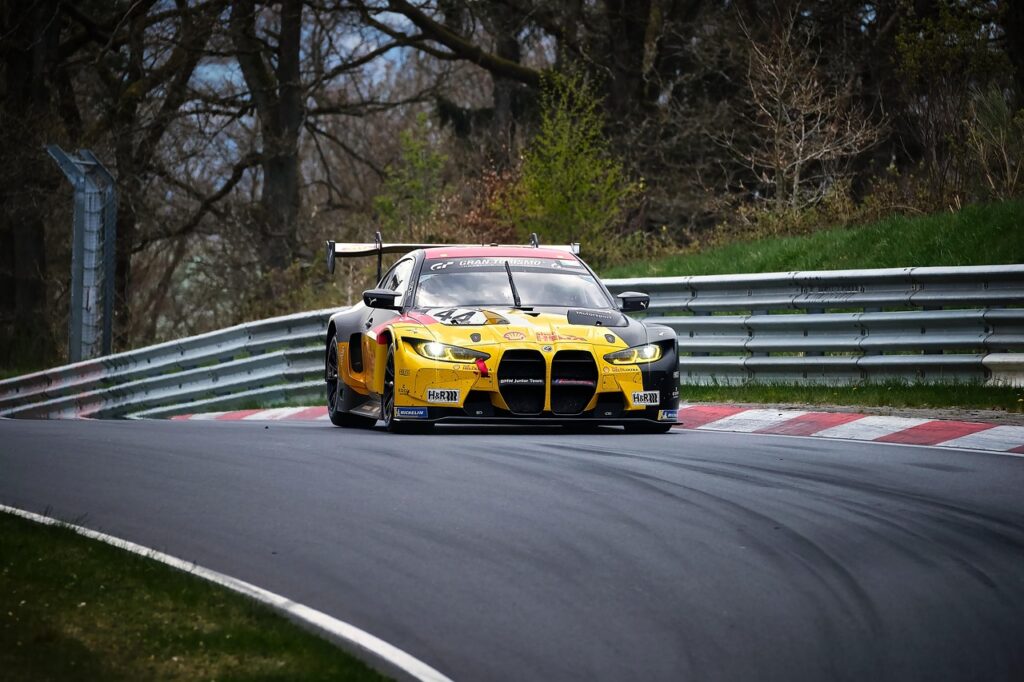
Major motorsport events can attract tens or even hundreds of thousands of spectators across a race weekend. These visitors don’t remain in one location. They continuously move between entrances, grandstands, merchandise stores, toilets, restaurants, fan zones and transport facilities.
That creates enormous logistical challenges.
Race Track Crowd Management aims to keep those movements predictable and safe while ensuring spectators can enjoy the event without spending excessive amounts of time trapped in queues.
Organisers need to understand where congestion is developing and why. A pedestrian route that works perfectly during a race may suddenly become overwhelmed once thousands of spectators leave their seats simultaneously.
Technology provides operators with considerably greater visibility over these changing conditions.
Smart Ticketing Controls Entry Flow
The first major crowd-management challenge occurs before spectators even enter the circuit.
Digital tickets, QR codes, RFID wristbands and automated access gates can process visitors considerably faster than traditional manual ticket inspections. They can also provide valuable information about when and where people are entering.
Modern Race Track Crowd Management systems can use this information to identify entrances experiencing unusual congestion.
Instead of waiting until queues become visually obvious, operations teams may see the problem developing through their monitoring platforms.
Digital communication channels can then direct arriving spectators towards quieter entrances where appropriate.
Smart access systems can also restrict entry into controlled areas such as paddocks, hospitality zones and specific grandstands without requiring every checkpoint to rely entirely on manual verification.
Cameras and AI Can Monitor Crowd Density
CCTV networks have been part of major sporting venues for decades, but intelligent video analytics can make them considerably more useful.
Computer-vision systems can analyse camera feeds to estimate crowd density and pedestrian movement without requiring operators to manually watch every screen continuously.
For Race Track Crowd Management, this can help identify locations where spectator numbers are approaching unsafe levels.
Systems may detect unusual movement patterns, rapidly increasing queues or areas where pedestrians have unexpectedly stopped moving.
Operators can then investigate the situation and determine whether intervention is necessary.
Importantly, AI doesn’t need to replace human decision-making. Its greatest value may be helping control-room personnel understand what’s happening across an enormous facility quickly enough to make informed decisions.
Digital Twins Can Simulate Spectator Movement
Digital twins are becoming increasingly valuable across infrastructure and facility management, and race circuits provide an interesting environment for their application.
A digital representation of the venue can incorporate grandstands, pathways, gates, bridges, tunnels, parking facilities and public transport connections.
For Race Track Crowd Management, organisers can potentially use these models to simulate how spectators might move through the venue under different circumstances.
They could examine scenarios such as:
- Spectators simultaneously leaving multiple grandstands
- An entrance or pedestrian bridge becoming unavailable
- Heavy congestion developing around a popular fan zone
- Emergency evacuation from a particular circuit section
- Increased pedestrian traffic following the end of a race
These simulations can expose potential bottlenecks before an event takes place.
Digital twins become even more valuable when connected with real-world sensor information, allowing operators to compare predicted crowd behaviour with actual conditions.
Digital Signage Helps Redirect Spectators
Knowing that congestion exists is only useful if organisers can do something about it.
That’s where communication infrastructure becomes an important component of Race Track Crowd Management.
Digital displays positioned throughout a venue can provide directional information and change their messages according to current conditions.
If one exit becomes overcrowded, signs could direct spectators towards an alternative route. If a shuttle service changes location, visitors can receive updated instructions without relying exclusively on staff members.
Circuit mobile applications can extend this communication directly to spectators’ phones.
Push notifications could provide information about gate closures, transport changes, weather conditions or emergency instructions.
The combination of physical signage and digital communication gives operators multiple ways to influence how people move through the venue.
Transport and Parking Are Part of the System
Crowd management doesn’t stop at the circuit gates.
Thousands of people arriving or departing simultaneously can overwhelm surrounding roads, railway stations, shuttle facilities and parking areas.
Effective Race Track Crowd Management therefore needs to consider the complete visitor journey.
Parking sensors, traffic-management systems and public-transport information can potentially be integrated into event operations.
Visitors might receive recommendations about which parking area to use based on current occupancy, while shuttle buses could be allocated according to real passenger demand.
Better coordination can also support sustainability objectives.
If organisers make public transport and shared shuttle services easier and more reliable, spectators may have less incentive to travel individually by car. That can reduce congestion around the circuit while potentially lowering the environmental impact associated with major events.
Technology Can Strengthen Emergency Planning
The greatest test of any crowd-management strategy may occur when something goes wrong.
Severe weather, fire, infrastructure failures or other emergencies can require thousands of people to move quickly and safely.
Technology can strengthen Race Track Crowd Management by giving emergency teams access to real-time information about where spectators are concentrated.
Rather than relying solely on predetermined evacuation assumptions, operators may be able to understand actual conditions across the venue.
Connected public-address systems, digital signage and mobile notifications can then distribute instructions through multiple channels.
Digital simulations conducted before an event can also help planners evaluate evacuation routes and identify areas where additional capacity or emergency personnel may be required.
Technology cannot eliminate every risk, but better information can improve how quickly organisers respond.
Sustainability Through Smarter Infrastructure
There is another advantage to intelligent crowd-management technology: race tracks can potentially make better use of infrastructure they already have.
Without detailed information, the obvious solution to congestion might be building another entrance, expanding a pathway or creating additional parking.
Data may reveal that the existing infrastructure isn’t necessarily too small. It may simply be used inefficiently.
Race Track Crowd Management technology can help operators identify where capacity genuinely needs to increase and where better scheduling, signage or routing could solve the problem instead.
That distinction matters from a sustainability perspective.
Construction consumes materials, energy and land. Optimising existing infrastructure before expanding it can reduce unnecessary development while potentially lowering operating costs.
Building Smarter Motorsport Venues
Race circuits are gradually becoming connected ecosystems where buildings, transport, energy systems, security networks and digital platforms work together.
Crowd management belongs within that wider transformation.
The future of Race Track Crowd Management may involve increasingly sophisticated combinations of digital twins, sensors, AI analytics, smart tickets, mobile applications and real-time transport information.
However, the objective remains remarkably simple.
People need to enter safely, move comfortably, understand where they need to go and leave efficiently when the event ends.
The best technology may ultimately be the technology spectators barely notice.
When thousands of motorsport fans can move through a circuit smoothly while organisers quietly analyse conditions behind the scenes, Race Track Crowd Management becomes part of the invisible infrastructure that makes a modern racing event possible.