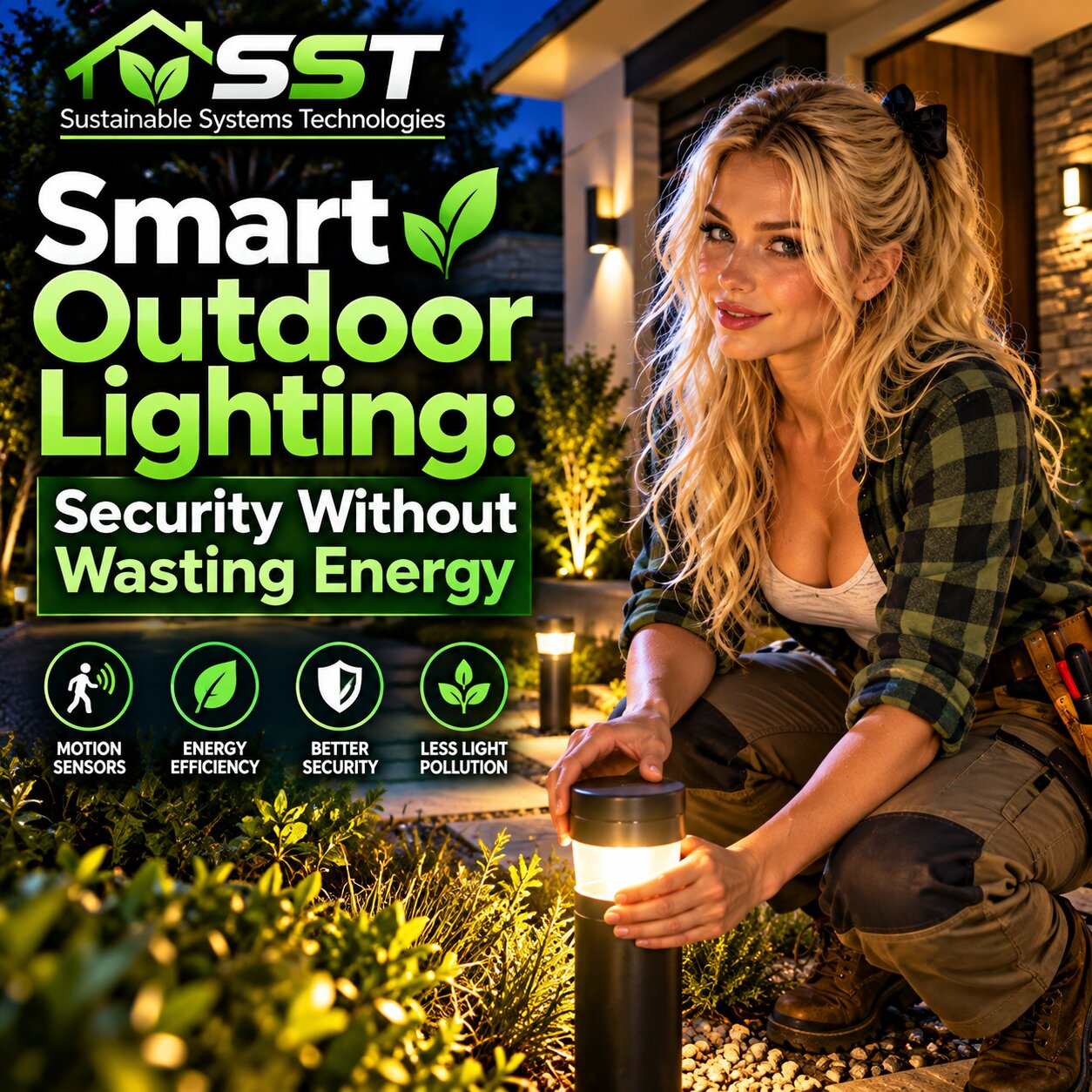
Outdoor lighting plays an important role in residential and commercial security, but poorly designed systems can waste electricity and contribute to unnecessary light pollution. Leaving powerful floodlights running throughout the night might illuminate a property, yet it does not necessarily provide the most efficient or effective solution.
Smart outdoor lighting offers an alternative by combining efficient lighting technologies with sensors, scheduling controls and thoughtful placement. These systems can improve visibility when needed while reducing energy consumption during periods of inactivity.
How Smart Outdoor Lighting Works
Traditional outdoor lighting often relies on manual switches or fixed operating schedules. Smart systems introduce greater flexibility by responding to environmental conditions, movement or programmed instructions.
Motion sensors can activate lights when someone approaches an entrance, while daylight sensors prevent unnecessary operation during bright conditions. Timers and connected controllers allow property owners to establish lighting schedules that match actual requirements.
Some smart outdoor lighting systems also support remote management through mobile applications or building management platforms. This makes it possible to adjust settings without physically accessing individual fixtures.
However, advanced connectivity is not always necessary. A properly installed LED floodlight with a reliable motion sensor may provide sufficient functionality for many residential applications.
Improving Security Through Thoughtful Design
Security lighting should help occupants and surveillance systems identify movement without producing excessive glare. Extremely bright fixtures can create harsh shadows, potentially making surrounding areas more difficult to observe.
Effective lighting design considers the location of entrances, pathways, parking areas and other vulnerable points. Fixtures should illuminate these spaces without directing unnecessary light into neighbouring properties or surrounding environments.
Several practical technologies can support an efficient installation:
- LED luminaires that consume less electricity than many older lighting technologies.
- Passive infrared motion sensors that respond to movement.
- Photocells that detect changes in natural daylight.
- Programmable timers that control operating hours.
- Adjustable fixtures that direct light towards specific areas.
- Smart controllers that coordinate multiple lighting zones.
Combining these features allows lighting to operate according to actual needs rather than remaining permanently illuminated.
Energy Efficiency and Long-Term Costs
One of the main advantages of smart outdoor lighting is the potential reduction in electricity consumption. LED technology already offers substantial efficiency improvements compared with many traditional incandescent and halogen alternatives.
Adding motion detection and scheduling can further reduce operating hours. For example, a pathway light that activates only when someone approaches may consume considerably less electricity than a fixture operating continuously throughout the night.
Actual savings depend on several factors, including fixture wattage, operating duration, sensor settings and the previous lighting arrangement. Property owners should therefore assess expected usage before calculating potential financial benefits.
Maintenance costs also deserve consideration. Quality LED fixtures typically require less frequent lamp replacement, although drivers, sensors and other electronic components may still need attention over time.
Reducing Light Pollution
Excessive outdoor lighting affects more than electricity bills. Poorly directed fixtures contribute to skyglow, disrupt nocturnal wildlife and create unwanted illumination around neighbouring properties.
Smart outdoor lighting can reduce these effects by ensuring that illumination is available only where and when necessary. Shielded fixtures help direct light downwards, while appropriate colour temperatures and brightness levels can minimise unnecessary environmental impacts.
Warm-coloured lighting is often preferable where suitable for the application, particularly in areas where wildlife sensitivity and residential comfort are important considerations.
The objective is not to eliminate outdoor illumination but to use it responsibly.
A Smarter Approach to Property Lighting
Smart outdoor lighting demonstrates how security, convenience and sustainability can work together. Efficient fixtures, responsive controls and careful placement allow property owners to improve visibility without relying on excessive electricity consumption.
For residential developments, commercial facilities and public spaces, thoughtful lighting design can support both operational efficiency and environmental responsibility.
The most effective solution is not necessarily the brightest or most technologically complicated. It is the system that delivers appropriate illumination at the right time and in the right location.