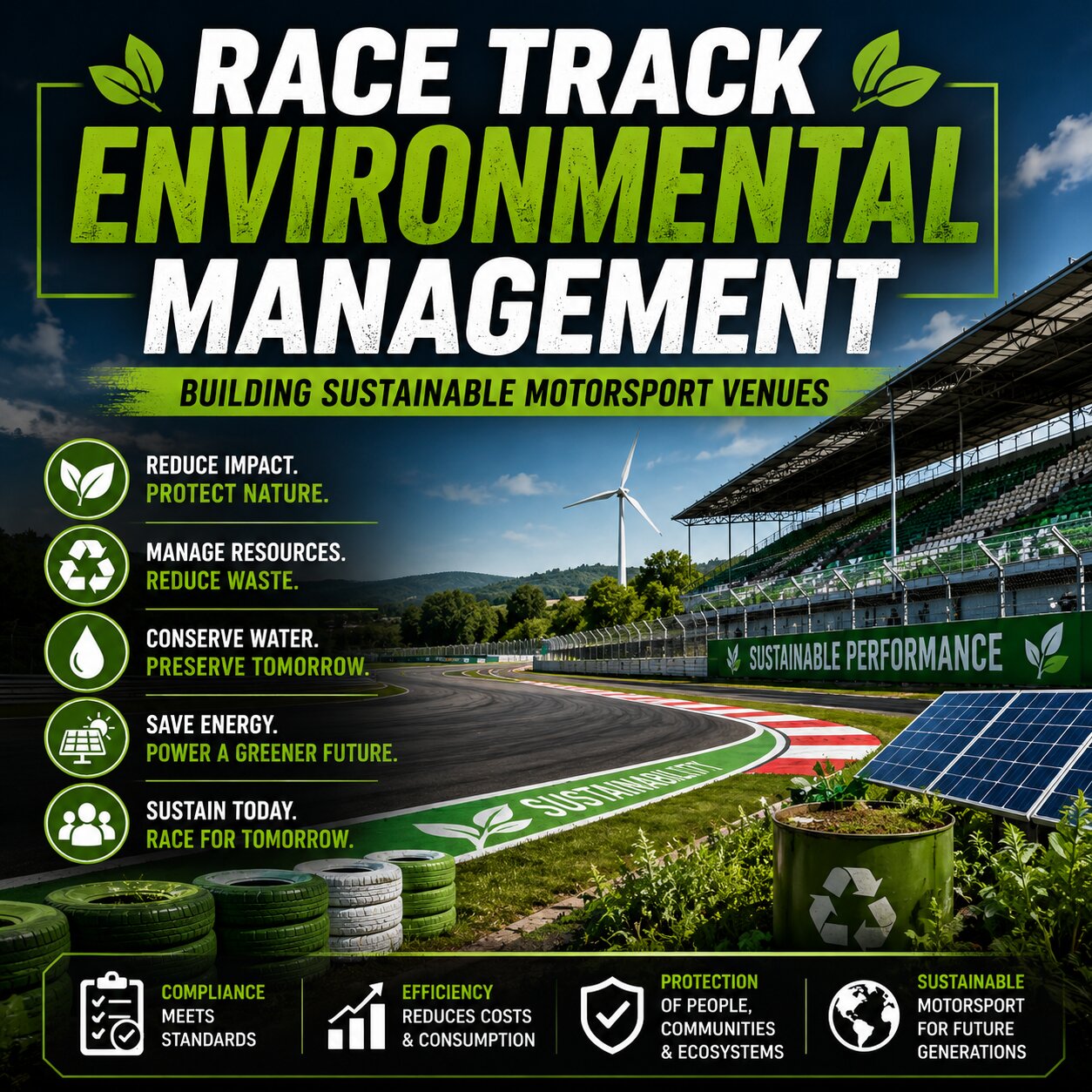
Modern motorsport venues are no longer judged solely on the quality of their racing. Today, race track environmental management has become an essential part of operating safe, sustainable, and community-friendly circuits. From reducing carbon emissions and protecting local ecosystems to managing waste and conserving water, environmental management ensures race tracks can continue hosting world-class events while minimising their ecological footprint.
Whether managing a permanent racing circuit, karting venue, drag strip, or multi-purpose motorsport facility, implementing effective environmental practices benefits organisers, competitors, spectators, and surrounding communities alike.
Why Race Track Environmental Management Matters

Motorsport facilities consume significant resources throughout the year. Large crowds, racing vehicles, maintenance equipment, catering services, and landscaping all contribute to environmental impacts that require careful planning.
Effective race track environmental management helps operators comply with environmental regulations while reducing operational costs through better resource efficiency.
It also improves relationships with local authorities and neighbouring communities by demonstrating a commitment to responsible environmental stewardship. Many racing organisations now expect venues to meet increasingly strict sustainability standards before hosting major championships.
For facility owners, environmental management is no longer simply about compliance. It has become an important part of long-term business success.
Key Areas of Environmental Management
A successful environmental management programme covers numerous operational areas throughout the facility.
One of the most important priorities is waste management. Recycling programmes, proper disposal of hazardous materials, tyre recycling, and reducing single-use plastics all contribute to cleaner events and lower landfill volumes.
Water conservation also plays a major role. Rainwater harvesting, efficient irrigation systems, leak detection, and water recycling help reduce consumption while maintaining landscaped areas and facility operations.
Energy efficiency is another growing focus. LED lighting, solar energy installations, energy monitoring systems, and smart building controls reduce electricity consumption across garages, paddocks, hospitality facilities, and administration buildings.
Noise monitoring is equally important, particularly for circuits located near residential areas. Careful scheduling, sound barriers, vegetation buffers, and ongoing monitoring help minimise disruption to neighbouring communities.
Protecting Local Ecosystems

Many race tracks occupy large areas of land containing valuable natural habitats. Effective race track environmental management ensures these ecosystems remain protected throughout daily operations and major events.
Environmental teams regularly monitor wildlife activity, protect sensitive vegetation, and establish conservation zones where development is restricted.
Drainage systems are carefully designed to prevent contaminated runoff from entering nearby rivers or wetlands. Oil separators, spill response procedures, and regular water quality testing all help protect surrounding ecosystems.
When circuits undergo expansion or redevelopment, environmental impact assessments guide planning decisions to minimise habitat disruption and preserve biodiversity wherever possible.
Supporting Sustainable Motorsport Events
Major motorsport events present unique environmental challenges due to increased visitor numbers and temporary infrastructure.
Event organisers work closely with circuit management to develop sustainability plans covering transport, waste management, energy usage, catering, and visitor education.
Common initiatives include:
- Recycling and waste separation stations.
- Public transport and shuttle services.
- Electric vehicle charging facilities.
- Refillable water stations.
- Sustainable catering practices.
- Carbon reduction initiatives.
- Environmentally responsible supplier requirements.
These measures reduce environmental impacts while improving the experience for teams, sponsors, and spectators who increasingly value sustainable sporting events.
Technology Driving Better Environmental Performance
Technology continues transforming race track environmental management through improved monitoring and data-driven decision-making.
Environmental sensors can monitor air quality, water quality, energy consumption, weather conditions, and noise levels in real time. Automated irrigation systems respond to changing weather conditions, reducing unnecessary water usage.
Building management systems optimise heating, ventilation, and lighting based on occupancy, while predictive maintenance reduces equipment failures that could lead to environmental incidents.
Data collected throughout the facility enables managers to identify trends, measure sustainability performance, and continuously improve environmental initiatives year after year.
Creating a More Sustainable Future
As motorsport embraces sustainability, race track environmental management will remain one of the most important responsibilities for facility operators worldwide.
Combining responsible resource management, environmental protection, modern technology, and continuous improvement allows race tracks to reduce their ecological footprint while maintaining the excitement fans expect from world-class motorsport.
At Sustainable Systems Tech, we help motorsport facilities explore innovative approaches to race track environmental management, supporting safer, more efficient, and environmentally responsible racing venues for future generations.